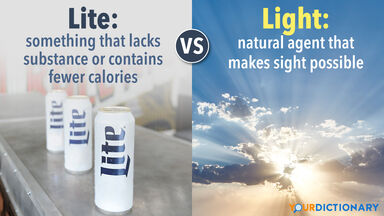
Light is defined as radiation that acts upon on the retina of the eye to make site possible.
(noun)An example of light is the sun.
The definition of light is being pale, not deep or dark.
(adjective)An example of light is the color of baby blue.
Light means to make something burn or illuminate.
(verb)An example of light is to use a match to make a candle burn.
See light in Webster's New World College Dictionary
noun
Origin: ME liht < OE lēoht, akin to Ger licht < IE base *leuk-, to shine, bright > Gr leukos, white, L lux & lumen, light, lucere, to shine, luna, moon, Welsh llug, gleam
adjective
Origin: ME liht < OE leoht
adverb
transitive verb lighted or lit, lighting
Origin: ME lighten < OE lihtan
intransitive verb
adjective
Origin: ME < OE lēoht, akin to Ger leicht, Du licht < IE *lengwhto- < base *legwh-, light in movement and weight > L levis, Gr elaphros
adverb
intransitive verb lighted or lit, lighting
Origin: ME lihten < OE līhtan: also aphetic for alight
Related Forms:
See light in American Heritage Dictionary 4
noun
Origin:
Origin: Middle English
Origin: , from Old English lēoht, līht; see leuk- in Indo-European roots
. Usage Note: Lighted and lit are equally acceptable as past tense and past participle of light. Both forms are also well established as adjectives: a lighted (or lit) candle.adjective light·er, light·est
Origin:
Origin: Middle English
Origin: , from Old English lēoht, līht; see legwh- in Indo-European roots
.See light in Ologies
Light
the study of the chemical effects of light in the violet and ultraviolet wavelengths. —actinologic, actinological, adj.
the measurement of the heating power of light in the violet and ultraviolet range. —actinometrist, n. —actinometric, actinometrical, adj.
the ratio between the light reflected from a surf ace and the total light falling upon that surf ace, as the albedo of the moon.
double refraction; the separation of light into two unequally refracted, polarized rays, as by some crystals. —birefringent, adj.
catadioptrics
the study of the reflection and refraction of light. —catadioptric, catadioptrical, adj.
the study of light reflection. —catoptric, catoptrical, adj. —catoptrically, adv.
the condition or quality of changing in color or luster depending on the angle of light, especially of a gemstone that reflects a single shaft of light when cut in cabochon form. —chatoyant, adj.
a property, peculiar to certain crystals, of reflecting light in two different colors when viewed from two different directions. —dichroic, adj.
the study of light refraction. —dioptric, adj.
the state or condition of being colored like a rainbow or like the light shining through a prism. —iridescent, adj.
iriscope
a polished black glass, the surface of which becomes iridescent when it is breathed upon through a tube.
rotation toward the left; counterclockwise rotation, a characteristic of the plane of polarization of light. —levorotatory, adj.
lithophany
the process of impressing porcelain objects, as lamp bases, with figures that become translucent when light is placed within or behind them. —lithophanic, adj.
any thing or creature that shines or glows in the dark, especially a phosphorescent or bioluminescent marine or other organism. —noctilucine, adj.
opties
the study of the properties of light. Also called photology. —optic, optical, adj.
pharology
the study of signal lights, especially lighthouses.
phengophobia
an abnormal fear of daylight.
pain in the eyes caused by light.
photangiophobia
an abnormal fear of photalgia.
photics
the study of light.
photodrome
1. an apparatus that regulates light flashes so that a rotating object appears to be stationary or moving in a direction opposite to its actual motion.
2. an apparatus for producing unusual optical effects by flashing light upon disks bearing various figures, patterns, etc.
the science or study of light in relation to the movement of plants. —photodynamic, photodynamical, adj.
the process or art of creating and recording images of people, objects, and phenomena, essentially by means of reflected light or emanating radiation. —photographer, n. —photographic, photographical, adj.
movement of bodies, organisms, etc., in response to the stimulus of light. —photokinetic, adj.
photology
optics.
the breakdown of matter or materials under the influence of light. —photolytic, adj.
photomania
an abnormal love of light.
the measurement of the intensity of light. —photometrician, photometrist, n. —photometric, adj.
photopathy
a pathologic effect produced by light. —photopathic, adj.
the tendency to thrive in strong light, as plants. —photophilic, adj.
1. an abnormal fear of light.
2. Also called photodysphoria. a painful sensitivity to light, especially visually.
3. a tendency to thrive in reduced light, as certain plants.
the synthesis of complex organic substances from carbon dioxide, water, and inorganic salts, with sunlight as the energy source and a catalyst such as chlorophyll. —photosynthetic, adj.
the movement of an organism away from or toward a source of light. —phototactic, adj.
the treatment of disease, especially diseases of the skin, with light rays. —phototherapeutic, adj.
motion in a particular direction under the stimulus of light, as manifested by certain plants, organisms, etc. —phototropic, adj.
the measurement of the polarization of light, as with a polarimeter.
selaphobia
an abnormal fear or dislike of flashes of light.
a photograph of a spectrum. Also called spectrograph.
1. an optical device for breaking light down into a spectrum and recording the results photographically.
2. spectrogram. —spectrographic, adj.
the technique of using a spectrograph and producing spectrograms.
a form of Iuminescence created by friction. —triboluminescent, adj.
Learn more about light
Related Articles