fair

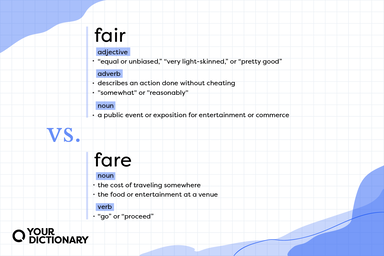
The definition of fair is someone or something that is light in color, attractive, honest or clear and sunny.

(adjective)

  1. An example of fair is blonde hair.
  2. An example of fair is a beautiful woman.
  3. An example of fair is an unbiased judge.
  4. An example of fair is a day full of sunshine.

YourDictionary definition and usage example. Copyright © 2013 by LoveToKnow Corp.

See fair in Webster's New World College Dictionary

adjective

  1. attractive; beautiful; lovely
  2. unblemished; clean: a fair name
  3. Origin: < notion that light coloring was desirable

    light in color; blond: fair hair
  4. clear and sunny; free from storm or the threat of storm
  5. easy to read; clear: a fair hand
  6. just and honest; impartial; unprejudiced; specif., free from discrimination based on race, religion, sex, etc.: fair employment practices, fair housing
  7. according to the rules: a fair blow
  8. likely; promising; advantageous: he is in a fair way to make money
  9. pleasant and courteous
  10. favorable; helpful: a fair wind
  11. of moderately good size: a fair fortune
  12. neither very bad nor very good; average: in fair condition
  13. apparently favorable but really false; specious: fair words
  14. Archaic without obstacles; clear and open: a fair road
  15. Baseball of or having to do with the part of the field on or between the foul lines, including home plate

Origin: ME < OE fæger, akin to fain, Goth fagrs, apt, fit < IE base *pek-, to be content, make (something) pretty > Lith púošiu, to ornament

noun

  1. Obsolete beauty
  2. Archaic a woman
  3. Archaic something fair, or good

adverb

  1. in a fair manner
  2. straight; squarely: struck fair in the face
  3. Baseball in or into the part of the field that is on or between the foul lines, including home plate

intransitive verb

Dialectal to become clear: said of the weather

transitive verb

to give a smooth or streamlined surface to

Related Forms:

noun

  1. Historical a gathering of people held at regular intervals for barter and sale of goods
  2. a festival or carnival where there is entertainment and things are sold, often for charity; bazaar
    1. an event consisting of a usually competitive exhibition of livestock, handicrafts, garden produce, etc. plus amusement facilities and educational displays
    2. world's fair
    3. any of various shows or conventions on a particular theme, typically consisting of booths, educational exhibits, vendors, etc.: usually in combination: science fair, book fair

Origin: ME feire < OFr < ML feria < LL, holiday (in LL(Ec), weekday) < L feriae, pl., festivals < OL fesiae, akin to L festus (see feast) < IE base *dhēs-, used in religious terms > Oscan fíísnu, temple, Arm dikʼ, gods

See fair in American Heritage Dictionary 4

adjective fair·er, fair·est
  1. Of pleasing appearance, especially because of a pure or fresh quality; comely.
  2. a. Light in color, especially blond: fair hair.
    b. Of light complexion: fair skin.
  3. Free of clouds or storms; clear and sunny: fair skies.
  4. Free of blemishes or stains; clean and pure: one's fair name.
  5. Promising; likely: We're in a fair way to succeed.
  6. a. Having or exhibiting a disposition that is free of favoritism or bias; impartial: a fair mediator.
    b. Just to all parties; equitable: a compromise that is fair to both factions.
  7. Being in accordance with relative merit or significance: She wanted to receive her fair share of the proceeds.
  8. Consistent with rules, logic, or ethics: a fair tactic.
  9. Moderately good; acceptable or satisfactory: gave only a fair performance of the play; in fair health.
  10. Superficially true or appealing; specious: Don't trust his fair promises.
  11. Lawful to hunt or attack: fair game.
  12. Archaic Free of all obstacles.
adverb
  1. In a proper or legal manner: playing fair.
  2. Directly; straight: a blow caught fair in the stomach.
transitive verb faired, fair·ing, fairs
To join (pieces) so as to be smooth, even, or regular: faired the aircraft's wing into the fuselage.
noun
  1. Archaic A beautiful or beloved woman.
  2. Obsolete Loveliness; beauty.
Phrasal Verb: fair off/up Chiefly Southern U.S. To become clear. Used of weather.

Origin:

Origin: Middle English

Origin: , from Old English fǽger, lovely, pleasant

.

Related Forms:

  • fairˈness noun
Regional Note: American folk speech puts Standard English to shame in its wealth of words for describing weather conditions. When the weather goes from fair to cloudy, New Englanders say that it's “breedin' up a storm” (Maine informant in the Linguistic Atlas of New England). If the weather is clear, however, a New Englander might call it open. Southern fair off and fair up, meaning “to become clear,” were originally Northeastern terms and were brought to the South as settlement expanded southward and westward. They are now “regionalized to the South,” according to Craig M. Carver, author of American Regional Dialects. These phrases may have prompted the coining of milding and milding down, noted respectively in Texas and Virginia by the Dictionary of American Regional English.

noun
  1. A gathering held at a specified time and place for the buying and selling of goods; a market.
  2. An exhibition, as of farm products or manufactured goods, usually accompanied by various competitions and entertainments: a state fair.
  3. An exhibition intended to inform people about a product or business opportunity: a computer fair; a job fair.
  4. An event, usually for the benefit of a charity or public institution, including entertainment and the sale of goods; a bazaar: a church fair.

Origin:

Origin: Middle English faire

Origin: , from Old French feire

Origin: , from Late Latin fēria

Origin: , sing. of Latin fēriae, holidays; see dhēs- in Indo-European roots

.

Learn more about fair

Related Articles

fair

link/cite print suggestion box