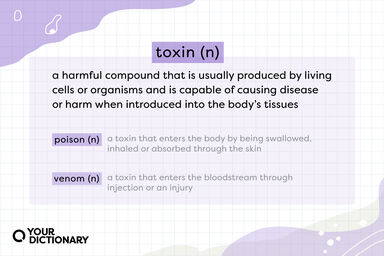
The definition of a poison is a substance that destroys, makes sick or kills, or anything that is harmful to happiness.
(noun)Poison is defined as to give or put in a substance that destroys, makes sick or kills, or to corrupt a mind.
(verb)See poison in Webster's New World College Dictionary
noun
Origin: OFr < L potio, potion
transitive verb
adjective
Related Forms:
See poison in American Heritage Dictionary 4
noun
Origin:
Origin: Middle English
Origin: , from Old French
Origin: , from Latin pōtiō, pōtiōn-, drink; see pō(i)- in Indo-European roots
.Related Forms:
See poison in Ologies
Poison
See also death; drugs; killing.
a remedy for or antidote against poison or infection. —alexipharmic, adj.
atropism
poisoning caused by atropine or belladonna.
a condition of chronic poisoning caused by excessive use of barbiturates.
a disease of the nervous system caused by botulin developments in spoiled foods eaten by animals and man; a variety of bacterial food poisoning.
cantharidism
a toxic condition caused by the misuse of the counterirritant and diuretic cantharides.
enriositatis
drunkenness or intoxication from alcohol, especially as an habitual state.
enterotoxemia
a condition in which the blood contains toxin from the intestines.
a condition caused by eating rye or some other grain infected with ergot fungus or by an overdose of an ergot medicinal agent.
iophobia
an abnormal fear of poisons. Cf. toxiphobia.
mephitism
mephitic or carbon dioxide poisoning. —mephitic, mephitical, adj.
the production of immunity against the action of a poison by consuming it regularly in gradually larger doses.
any of a variety of toxic conditions produced by poisonous mush-rooms. Also mycetismus.
chronic phosphorus poisoning.
an acute toxic condition caused by the absorption of lead into the body by skin contact, ingestion, or inhalation; lead poisoning. Also called saturnism.
plutonism
a poisoning caused by exposure to radioactive plutonium.
excessive salivation, usually associated with chronic mercury poisoning.
a substance that kills rodents.
a toxic condition produced by excessive intake of salicylic acid, marked by vomiting and ringing in the ears.
an illness caused by food tainted with certain species of salmonella bacteria.
blood poisoning caused by putrefactive microorganisms in the bloodstream.
plumbism.
blood poisoning caused by pathogenic microorganisms and their toxic products in the bloodstream. —septicemic, septicaemic, adj.
poisoning from antimony.
strychnism
a toxic condition caused by excessive use of strychnine.
tabacism
addiction to tobacco; poisoning from excessive use of tobacco. Also called tabagism, tobaccoism.
thebaism
Archaic. a toxic condition produced by thebaine, a derivative of opium.
the branch of medical science that studies the effects, antidotes, detection, etc., of poisons. —toxicologist, n. —toxicologie, toxicological, adj.
toxiphobia
an abnormal fear of poisoning. Also called toxicophobia. Cf. iophobia. —toxiphobe, toxiphobiac, n.
tyrotoxism
poisoning caused by microbes in stale cheese or milk.
urotoxy, urotoxia
1. the toxicity or toxic content of urine.
2. the unit used in measuring the toxicity of urine, a quantity sufficient to kill an animal weighing one kilogram. —urotoxic, adj.
Learn more about poison