Bacteria Definition
baktirēə
bacterium
noun
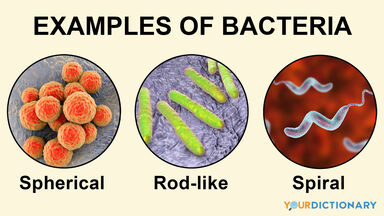
Any of a division (Bacteria) of monerans, microorganisms which are typically one-celled, have no chlorophyll, multiply by simple division, and can be seen only with a microscope: they occur in three main forms, spherical (cocci), rod-shaped (bacilli), and spiral (spirilla): some bacteria cause diseases such as pneumonia and anthrax, and others are necessary for fermentation, nitrogen fixation, etc.
Webster's New World
Plural form of bacterium.
Wiktionary
(US) A type, species, or strain of bacterium.
Wiktionary
(US, proscribed) Alternative form of bacterium.
Wiktionary
pronoun
In the two-empire system, a taxonomic kingdom, within domain Prokaryota: single cell organisms (the bacteria); once divided into the Archaebacteria and Eubacteria.
Wiktionary
Other Word Forms of Bacteria
Noun
Singular:
bacteriaPlural:
bacteriaeOrigin of Bacteria
-
From New Latin bacteria, plural of bacterium, from Ancient Greek βακτήριον (baktērion), neuter diminutive of βακτηρία (baktēria, “rod, stick”).
From Wiktionary
From New Latin bacteria, from Ancient Greek βακτηρία (baktēria, “rod, stick”).
From Wiktionary
From Ancient Greek βακτηρία (baktēria, “rod”)
From Wiktionary



Find Similar Words
Find similar words to bacteria using the buttons below.