subject

A subject is someone or something that is under the authority of another or others.

(adjective)

An example of subject is having to obey rules.

The definition of subject is someone or something likely to do or be affected by something or someone.

(adjective)

An example of subject is a child who tends to throw fits when they don't get their way.

A subject is someone or something that is under the control of another.

(noun)

An example of subject is a person living in England being under the authority of the queen.

Subject means something or someone that is a topic of a discussion, writing, art piece or area of study.

(noun)

  1. An example of subject is a class about US History.
  2. An example of subject is a series of paintings featuring trees.

Subject is defined as to make someone or something experience something.

(verb)

An example of subject is leaving someone in the room with another person who won't stop talking.

YourDictionary definition and usage example. Copyright © 2013 by LoveToKnow Corp.

See subject in Webster's New World College Dictionary

adjective

  1. under the authority or control of, or owing allegiance to, another: subject peoples
  2. having a disposition or tendency; liable (to): subject to fits of anger
  3. liable to receive; exposed (to): subject to censure
  4. contingent or conditional upon (with to): subject to your approval

Origin: ME suget < OFr < L subjectus, pp. of subjicere, to place under, put under, subject < sub-, under + jacere, to throw: see jet

noun

  1. a person under the authority or control of another; esp., a person owing allegiance to a particular ruler, government, etc.
  2. someone or something made to undergo a treatment, experiment, analysis, dissection, etc.
  3. Origin: L subjectum, foundation, subject (transl. of Gr to hypokeimenon) < neut. of subjectus: see subjectthe

    something dealt with in discussion, study, writing, painting, etc.; theme
  4. the main theme or melody of a musical composition or movement, esp., the opening theme in a fugue
  5. originating cause, reason, or motive
  6. any of the various courses of study in a school or college; branch of learning
  7. Gram. the noun or other substantive that is one of the two immediate constituents of a sentence and about which something is said in the predicate
  8. Logic that part of a proposition about which something is said; that which is affirmed or denied
  9. Philos.
    1. the actual substance of anything as distinguished from its qualities and attributes
    2. the mind, or ego, that thinks and feels, as distinguished from everything outside the mind

Origin: ME suget < OFr < L subjectus: see subjectthe

transitive verb

  1. Obsolete to place under or below
  2. to bring under the authority or control of; cause to owe allegiance
  3. to make liable or vulnerable: to subject oneself to the contempt of others
  4. to cause to experience or receive some action or treatment: to subject someone to interrogation, subject a new drug to rigorous testing
  5. Rare to place before; submit: a plan subjected for approval

Related Forms:

See subject in American Heritage Dictionary 4

adjective
  1. Being in a position or in circumstances that place one under the power or authority of another or others: subject to the law.
  2. Prone; disposed: a child who is subject to colds.
  3. Likely to incur or receive; exposed: a directive subject to misinterpretation.
  4. Contingent or dependent: a vacation subject to changing weather.
noun
  1. One who is under the rule of another or others, especially one who owes allegiance to a government or ruler.
  2. a. One concerning which something is said or done: a subject of gossip.
    b. Something that is treated or indicated in a work of art.
    c. Music A theme of a composition, especially a fugue.
  3. A course or area of study: Math is her best subject.
  4. A basis for action; a cause.
  5. a. One that experiences or is subjected to something: the subject of ridicule.
    b. A person or animal that is the object of medical or scientific study: The experiment involved 12 subjects.
    c. A corpse intended for anatomical study and dissection.
    d. One who is under surveillance: The subject was observed leaving the scene of the murder.
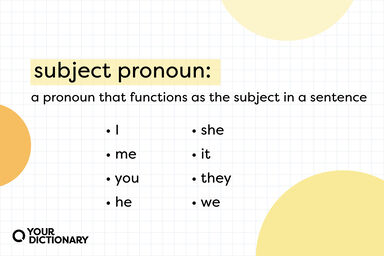
  6. Grammar The noun, noun phrase, or pronoun in a sentence or clause that denotes the doer of the action or what is described by the predicate.
  7. Logic The term of a proposition about which something is affirmed or denied.
  8. Philosophy
    a. The essential nature or substance of something as distinguished from its attributes.
    b. The mind or thinking part as distinguished from the object of thought.
transitive verb (səb-jĕktˈ) sub·ject·ed, sub·ject·ing, sub·jects
  1. To submit for consideration.
  2. To submit to the authority of.
  3. To expose to something: patients subjected to infection.
  4. To cause to experience: subjected to extreme weather.
  5. To subjugate; subdue.

Origin:

Origin: Middle English

Origin: , from Old French

Origin: , from Latin sūbiectus

Origin: , from past participle of sūbicere, to subject

Origin: : sub-, sub-

Origin: + iacere, to throw; see yē- in Indo-European roots

.

Related Forms:

  • sub·jecˈtion (səb-jĕkˈshən) noun

Learn more about subject

Related Articles

link/cite print suggestion box