verb passed,
pass·ing,
pass·es verb, intransitive- To move on or ahead; proceed.
- To extend; run: The river passes through our land.
a. To move by: The band passed and the crowd cheered.
b. To move past another vehicle: The sports car passed on the right.
- To gain passage despite obstacles: pass through difficult years.
- To move past in time; elapse: The days passed quickly.
a. To be transferred from one to another; circulate: The wine passed around the table.
b. Sports To transfer a ball or puck to a teammate.
- To be communicated or exchanged between persons: Loud words passed in the corridor.
- To be transferred or conveyed to another by will or deed: The title passed to the older heir.
- To undergo transition from one condition, form, quality, or characteristic to another: Daylight passed into darkness.
- To come to an end: My anger suddenly passed. The headache finally passed.
- To cease to exist; die. Often used with on: The patient passed on during the night.
- To happen; take place: What passed during the day?
a. To be allowed to happen without notice or challenge: Let their rude remarks pass.
b. Sports & Games To decline one's turn to bid, draw, bet, compete, or play.
c. To decline an offer: When we offered him dessert, he passed.
- To undergo an examination or a trial with favorable results.
a. To serve as a barely acceptable substitute: The spare tire was nearly bald but would pass until we bought a new one.
b. To be accepted as a member of a group by denying one's own ancestry or background.
- To be approved or adopted: The motion to adjourn passed.
- Law
a. To pronounce an opinion, judgment, or sentence.
b. To sit in adjudication.
- To be voided: Luckily the kidney stone passed before she had to be hospitalized.
- Sports To thrust or lunge in fencing.
verb, transitive- To go by without stopping; leave behind.
a. To go by without paying attention to; disregard or ignore: If you pass the new photographs in the collection, you'll miss some outstanding ones.
b. To fail to pay (a dividend).
- To go beyond; surpass: The inheritance passed my wildest dreams.
- To go across; go through: We passed the border into Mexico.
a. To undergo (a trial or examination) with favorable results: She passed every test.
b. To cause or allow to go through a trial, test, or examination successfully: The instructor passed all the candidates.
a. To cause to move: We passed our hands over the fabric.
b. To cause to move into a certain position: pass a ribbon around a package.
c. To cause to move as part of a process: pass liquid through a filter.
d. To cause to go by: The sergeant passed his troops before the general and halted them at the grandstand.
e. Baseball To walk (a batter).
f. To maneuver (the bull) by means of a pase in bullfighting.
- To allow to go by or elapse; spend: He passed his winter in Vermont.
- To allow to cross a barrier: The border guard passed the tourists.
a. To cause to be transferred from one to another; circulate: They passed the news quickly.
b. To hand over to someone else: Please pass the bread.
c. Sports To transfer (a ball, for example) to a teammate, as by throwing.
d. To cause to be accepted; circulate fraudulently: pass counterfeit money.
e. Law To transfer title or ownership of.
- To discharge (body waste, for example); void.
a. To approve; adopt: The legislature passed the bill.
b. To be sanctioned, ratified, or approved by: The bill passed the House of Representatives.
- To pronounce; utter: pass judgment; pass sentence on an offender.
noun- The act of passing; passage.
- A way, such as a narrow gap between mountains, that affords passage around, over, or through a barrier. See Synonyms at way.
a. A permit, ticket, or authorization to come and go at will.
b. A free ticket entitling one to transportation or admisssion.
c. Written leave of absence from military duty.
a. A sweep or run, as by an aircraft, over or toward an area or target.
b. A single complete cycle of operations, as by a machine or computer program.
- A condition or situation, often critical in nature; a predicament. See Synonyms at crisis.
- A sexual invitation or overture.
- A motion of the hand or the waving of a wand.
a. Sports A transfer of a ball or puck between teammates.
b. Sports A lunge or thrust in fencing.
c. Baseball A base on balls.
- Sports & Games A refusal to bid, draw, bet, compete, or play.
- Games A winning throw of the dice in craps.
- A pase in bullfighting.
Phrasal Verbs: pass away To pass out of existence; end. To die.
pass for To be accepted as or believed to be:
You could pass for a teenager. The fake painting passed for an original. pass off To offer, sell, or put into circulation (an imitation) as genuine:
pass off glass as a gemstone. To present (one's self) as other than what one is:
tried to pass himself off as a banker. pass out To lose consciousness.
pass over To leave out; disregard.
pass up Informal To let go by; reject:
pass up a chance for promotion; an opportunity too good to pass up.
Origin:
Origin: Middle English passen
Origin: , from Old French passer
Origin: , from Vulgar Latin passāre
Origin: , from Latin passus, step; see pace1
.
Related Forms:
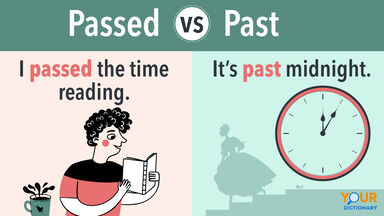
Usage Note: The past tense and past participle of
pass is
passed:
They passed (or have passed) our home. Time had passed slowly. Past is the corresponding adjective (
in centuries past), adverb (
drove past), preposition (
past midnight), and noun (
lived in the past).