lose

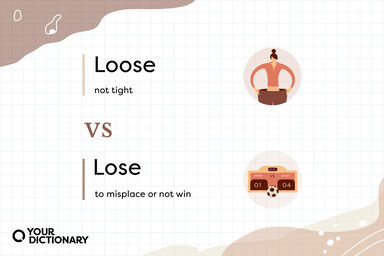
Lose is defined as to wind up without something or to fail in a competition.

(verb)

  1. An example of lose is to misplace your car keys.
  2. An example of lose is to play in a soccer game and score the least amount of points.

YourDictionary definition and usage example. Copyright © 2013 by LoveToKnow Corp.

See lose in Webster's New World College Dictionary

transitive verb lost, losing

    1. to bring to ruin or destruction: a ship lost in the storm
    2. Theol. to incur the damnation of: to lose one's soul
  1. to become unable to find; mislay: to lose one's keys
    1. to have taken from one by negligence, accident, death, removal, separation, etc.; suffer the loss of; be deprived of
    2. to suffer the miscarriage or stillbirth of (a baby)
  2. to get rid of (something undesirable): to lose unwanted weight
  3. to fail to keep or maintain: to lose one's temper, to lose speed
    1. to fail to see, hear, or understand: she did not lose a word of his speech
    2. to fail to keep in sight, mind, or existence
  4. to fail to have, get, take advantage of, etc.; miss: to lose one's chance
  5. to fail to win or gain: to lose a game
  6. to cause the loss of: it lost him his job
  7. to cause to go astray, become bewildered, etc.
  8. to wander from and not be able to find (one's way, the right track, etc.)
  9. to fail or be unable to make proper use of; waste: to lose time
  10. to leave behind; outdistance
  11. to engross or preoccupy: usually in the passive: to be lost in reverie
  12. to go slower by: a watch that loses two minutes a day

Origin: ME losen, lesen, merging OE losian, to lose, be lost (< los, loss) + leosan, to lose, akin to OHG (vir)liosan, Goth (fra)liusan < IE base *leu-, to cut off, separate > Gr lyein, to dissolve; L luere, to loose, release (from debt)

intransitive verb

  1. to undergo or suffer loss
  2. to be defeated in a contest, etc.
  3. to be slow: said of a clock, etc.

Related Forms:

See lose in American Heritage Dictionary 4

verb lost lost (lôst, lŏst), los·ing, los·es
verb, transitive
  1. To be unsuccessful in retaining possession of; mislay: He's always losing his car keys.
  2. a. To be deprived of (something one has had): lost her art collection in the fire; lost her job.
    b. To be left alone or desolate because of the death of: lost his wife.
    c. To be unable to keep alive: a doctor who has lost very few patients.
  3. To be unable to keep control or allegiance of: lost his temper at the meeting; is losing supporters by changing his mind.
  4. To fail to win; fail in: lost the game; lost the court case.
  5. To fail to use or take advantage of: Don't lose a chance to improve your position.
  6. To fail to hear, see, or understand: We lost the plane in the fog. I lost her when she started speaking about thermodynamics.
  7. a. To let (oneself) become unable to find the way.
    b. To remove (oneself), as from everyday reality into a fantasy world.
  8. To rid oneself of: lost five pounds.
  9. To consume aimlessly; waste: lost a week in idle occupations.
  10. To wander from or become ignorant of: lose one's way.
  11. a. To elude or outdistance: lost their pursuers.
    b. To be outdistanced by: chased the thieves but lost them.
  12. To become slow by (a specified amount of time). Used of a timepiece.
  13. To cause or result in the loss of: Failure to reply to the advertisement lost her the job.
  14. To cause to be destroyed. Usually used in the passive: Both planes were lost in the crash.
  15. To cause to be damned.
verb, intransitive
  1. To suffer loss.
  2. To be defeated.
  3. To operate or run slow. Used of a timepiece.
Phrasal Verb: lose out To fail to achieve or receive an expected gain.

Origin:

Origin: Middle English losen

Origin: , from Old English losian, to perish

Origin: , from los, loss; see leu- in Indo-European roots

.

Learn more about lose

link/cite print suggestion box