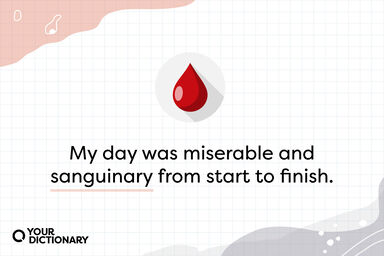
sanguine

The definition of sanguine is someone or something the color of blood or a reddish color.

(adjective)

An example of sanguine is rosy cheeks.

YourDictionary definition and usage example. Copyright © 2013 by LoveToKnow Corp.

See sanguine in Webster's New World College Dictionary

adjective

  1. of the color of blood; ruddy: said esp. of complexions
  2. in medieval physiology, having the warm, passionate, cheerful temperament and the healthy, ruddy complexion of one in whom the blood is the predominant humor of the four
  3. cheerful and confident; optimistic; hopeful
  4. Now Rare sanguinary (sense )

Origin: ME sanguin < MFr < L sanguineus < sanguis (gen. sanguinis), blood

Related Forms:

See sanguine in American Heritage Dictionary 4

adjective
  1. a. Of the color of blood; red.
    b. Of a healthy reddish color; ruddy: a sanguine complexion.
  2. Archaic
    a. Having blood as the dominant humor in terms of medieval physiology.
    b. Having the temperament and ruddy complexion formerly thought to be characteristic of a person dominated by this humor; passionate.
  3. Cheerfully confident; optimistic.

Origin:

Origin: Middle English

Origin: , from Old French sanguin

Origin: , from Latin sanguineus

Origin: , from sanguis, sanguin-, blood

.

Related Forms:

  • sanˈguine·ly adverb
  • sanˈguine·ness, san·guinˈi·ty noun
Word History: The similarity in form between sanguine, “cheerfully optimistic,” and sanguinary, “bloodthirsty,” may prompt one to wonder how they have come to have such different meanings. The explanation lies in medieval physiology with its notion of the four humors or bodily fluids (blood, bile, phlegm, and black bile). The relative proportions of these fluids was thought to determine a person's temperament. If blood was the predominant humor, one had a ruddy face and a disposition marked by courage, hope, and a readiness to fall in love. Such a temperament was called sanguine, the Middle English ancestor of our word sanguine. The source of the Middle English word was Old French sanguin, itself from Latin sanguineus. Both the Old French and Latin words meant “bloody,” “blood-colored,” Old French sanguin having the sense “sanguine in temperament” as well. Latin sanguineus was in turn derived from sanguis, “blood,” just as English sanguinary is. The English adjective sanguine, first recorded in Middle English before 1350, continues to refer to the cheerfulness and optimism that accompanied a sanguine temperament but no longer has any direct reference to medieval physiology.

Learn more about sanguine

link/cite print suggestion box