bud
bud (bud)
noun
- a small swelling or projection on a plant, from which a shoot, cluster of leaves, or flower develops
- a partly opened flower
- any undeveloped or immature person or thing
- an asexually produced swelling or growth on the body of a sponge, fungus, etc. that develops into a new individual
Etymology: ME budde, bud, seedpod < IE base *bheu-: see big
intransitive verb bud′·ded, bud′·ding
- to put forth buds
- to begin to develop
- to be young, promising, etc.
Etymology: < budthe
transitive verb
- to put forth as a bud or buds
- to cause to bud
- to insert (a bud of a plant) into the bark of another plant
in (the) bud
- in the time of budding
- in a budding condition
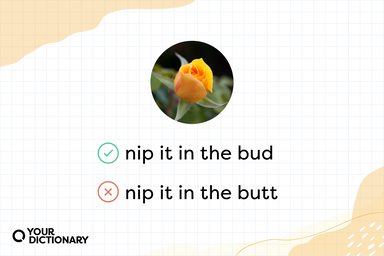
nip in the bud
to put an end to at the earliest stage
☆ bud (bud)
noun
Slang buddy (): used in addressing a man or boy
bud
n.
nip in the bud
Object
- entrepreneur: What advice would you have for budding young entrepreneurs?
- film-makers: Every Object Tells A Story asked budding film-makers to create a 30-second film that reflected the quirky nature of the project.
- yeast: They grow as budding yeasts in anaerobic conditions but as mycelia in the presence of even low concentrations of oxygen.
- archeologist: This is useful addition to any library and particularly interesting to budding archeologists and children with family ties to the region.
- shark: Filipino american men straight will impress budding card sharks.
Converse of object
- tickle: Of course there could be books, plays and poems, but music is also able to tickle the laughter buds.
- tempt: Then try SPAR Bordeaux Rouge to tempt the taste buds!
- tantalize: We offer excellent cuisine, with a great selection of authentic dishes to tantalize the taste buds.
Adjective modifier
- unopened: On any section of spike, there are blooms in all stages, from unopened bud to full flower.
- adventitious: Adventitious buds develop at the base of these side roots.
- dormant: Examine each branch and look for a pair of leaves where there are two tiny dormant buds in the leaf axil.
- axillary: A growth or flower bud ( " axillary bud " ) often appears in the axil.
- sticky: Spring How many sticky buds, candle ends sprout from the branches!
Modifies a noun
- vase: A charming antique bud vase, dating to circa 1870.
Noun used with modifier
- taste: Why are our taste buds drawn to the past?
- cotton: Clean the head using a clean cotton bud dipped in drive head cleaner or the cleaner used for tape recorder heads.
- lavender: Simple pot pourri Put dried lavender buds in decorative bowls throughout your house.
- flower: The first flower buds appear in spring are yellow, not red.
- lotus: All are on a detachable branch leading to a lotus bud.
- darling: The darling buds of May Meaning An appreciation of what is fresh and new.
As though a rose should shut, and be a bud again.
He brought light out of darkness, not out of a lesser light; he canbring thysummerout of winter, though thou have no spring God comes to thee, not as in the dawning of the day, not as in the bud of the spring, but as the sun at noontoillustrateall shadows,asthesheavesinharvestto fill all penuries. All occasions invite his mercies, and all times are his seasons.
Yo persigo una forma que no encuentra mi estilo, boto¤ n de pensamiento que busca ser la rosa; se anuncia con un beso que en mis labios se posa al abrazo imposible de laVenus de Milo. I seek a form that my style cannot discover, a bud of thought that wants to be a rose; it is heralded by a kiss that is placed on my lips in the impossible embrace of theVenus de Milo.
Is it not possible that the rage for confession, autobiography, especially for memories of earliest childhood, is explained by our persistent yet mysterious belief in a self which is continuous and permanent; which, untouched by all we acquire and all we shed, pushes a green spear through the dead leaves and throughthemould, thrusts a scaled bud through years of darkness until, one day, the light discovers it and shakes the flower free andöwe are aliveöwe are flowering for our moment upon the earth? This is the moment which after all, we live foröthe moment of direct feeling when we are most ourselves and least personal.