die

Die is defined as to stop living, existing or fade away.

(verb)

  1. An example of die is pulling a plant out of the ground by its' roots.
  2. An example of die is a person's heart stopping and their brain no longer having activity.

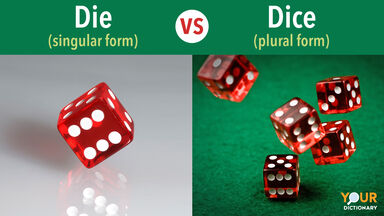
The definition of a die is a small marked cube used in games.

(noun)

An example of die is what is rolled when playing backgammon.

YourDictionary definition and usage example. Copyright © 2013 by LoveToKnow Corp.

See die in Webster's New World College Dictionary

intransitive verb died, dying

  1. to stop living; become dead
  2. to suffer the agony of death or an agony regarded as like it
    1. to cease existing; end
    2. to stop functioning
  3. to lose force or activity; become weak, faint, unimportant, etc.
  4. to fade or wither away
  5. to become alien or indifferent (to), as if dead
  6. to pine away, as with desire
  7. Informal to wish with extreme intensity; yearn: she's dying to learn the secret
  8. Theol. to suffer spiritual death

Origin: ME dien < ON deyja < IE base *dheu-, to pass away, become senseless > OS doian, to die, OE dead, OHG tot, dead

noun pl. dice , dies

  1. a small, marked cube used in games of chance
  2. any small cube resembling this
  3. Archit. a dado of a pedestal
  4. Mech. any of various tools or devices, originally cubical in form, for molding, stamping, cutting, or shaping; specif.,
    1. a piece of engraved metal used for stamping money, medals, etc.
    2. the stationary part of a machine for shaping or punching holes in sheet metal, etc.; matrix
    3. the punch and matrix as a unit
    4. a tool used for cutting threads, as of screws or bolts
    5. a piece of metal with a hole through it, used in drawing wire, extruding rods, etc.

Origin: ME de (pl. dis) < OFr de < VL *datum, orig. neut of L datus: see date

transitive verb died, dieing

to mold, stamp, cut, or shape with a die

See die in American Heritage Dictionary 4

intransitive verb died died, dy·ing (dīˈĭng), dies dies
  1. To cease living; become dead; expire.
  2. To cease existing, especially by degrees; fade: The sunlight died in the west.
  3. To experience an agony or suffering suggestive of that of death: nearly died of embarrassment.
  4. Informal To desire something greatly: I am dying for a box of chocolates. She was dying to see the exhibit.
  5. a. To cease operation; stop: If your vehicle dies, stay with it.
    b. To be destroyed, as in combat: could see the remains of two aircraft that had died in the attack.
  6. To become indifferent: had died to all worldly concerns.
Phrasal Verbs: die back Botany To be affected by dieback. die down To lose strength; subside: The winds died down. die off To undergo a sudden, sharp decline in population: Rabbits were dying off in that county. die out To cease living completely; become extinct: tribes and tribal customs that died out centuries ago.

Origin:

Origin: Middle English dien

Origin: , probably from Old Norse deyja; see dheu-2 in Indo-European roots

.

noun pl. dies dies or dice (dīs)
  1. pl. dies dies A device used for cutting out, forming, or stamping material, especially:
    a. An engraved metal piece used for impressing a design onto a softer metal, as in coining money.
    b. One of several component pieces that are fitted into a diestock to cut threads on screws or bolts.
    c. A part on a machine that punches shaped holes in, cuts, or forms sheet metal, cardboard, or other stock.
    d. A metal block containing small conical holes through which plastic, metal, or other ductile material is extruded or drawn.
  2. pl. dies dies Architecture The dado of a pedestal, especially when cube-shaped.
  3. pl. dice dice
    a. A small cube marked on each side with from one to six dots, usually used in pairs in gambling and in various other games.
    b. dice (used with a sing. verb) A game of chance using dice.
transitive verb died died, die·ing, dies dies
To cut, form, or stamp with or as if with a die.

Origin:

Origin: Middle English de, gaming die

Origin: , from Old French

Origin: , from Latin datum, given

Origin: , from

Origin: neuter past participle of dare, to give; see dō- in Indo-European roots

.

Learn more about die

die

link/cite print suggestion box