Begin Definition
bĭ-gĭn
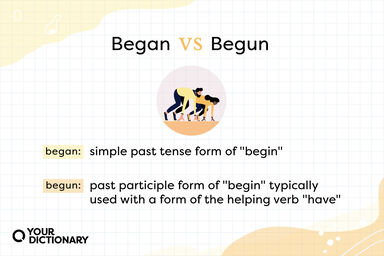
began, beginning, begins, begun
verb
began, beginning, begins, begun
To perform or undergo the first part of an action; start.
I began to e-mail you but got interrupted. The rain began around noon.
American Heritage
To start doing, acting, going, etc.; get under way.
Webster's New World
To cause to start; set about; commence.
Webster's New World
To come into being.
When life began.
American Heritage
To come into being; arise.
Webster's New World
Synonyms:
noun
idiom
to begin with
- as the first point or consideration
Webster's New World
Idioms, Phrasal Verbs Related to Begin
Origin of Begin
-
From Middle English beginnen, from Old English beginnan (“to begin”), from Proto-Germanic *biginnaną (“to begin”) (compare West Frisian begjinne, Low German begünnen, Dutch and German beginnen), from a root *ginnaną also found in Old English onginnan, Old Saxon andginnan and Dutch ontginnen, possibly from Proto-Indo-European *ghendhe/o (“to take”) (compare Welsh genni (“to delve, submerge onself”), Latin prehendō, Albanian zë (“to catch”), Ancient Greek [script?] (chandánein, “to hold, contain”)).
From Wiktionary
Middle English biginnen from Old English beginnan
From American Heritage Dictionary of the English Language, 5th Edition


Begin Is Also Mentioned In
Find Similar Words
Find similar words to begin using the buttons below.