spring

Spring is defined as to jump up or to originate from.

(verb)

  1. An example of spring is a jack-in-the-box leaping out of the toy's box.
  2. An example of spring is for a housing development to seem as if it quickly appears.

Spring is an elastic or bouncing ability or the season between winter and summer.

(noun)

  1. An example of spring is what is in a jack-in-the-box toy.
  2. An example of spring is the month of May.

Spring means a source of water from the ground, particularly a very small pond.

(noun)

An example of spring is the water outlet that forms a pond.

The definition of a spring is a coil that goes to its original shape after being compressed.

(noun)

An example of spring is the coil in a mattress.

YourDictionary definition and usage example. Copyright © 2013 by LoveToKnow Corp.

See spring in Webster's New World College Dictionary

intransitive verb sprang or sprung, sprung, springing

  1. to move suddenly and rapidly; specif.,
    1. to move upward or forward from the ground, etc. by suddenly contracting the muscles; leap; bound; also, to make a series of such leaps
    2. to rise suddenly and quickly from or as from a sitting or lying position: to spring to one's feet
    3. to come, appear, etc. suddenly and quickly: curses springing to his lips
    4. to move as a result of resilience; bounce
  2. to come or arise as from some source; specif.,
    1. to grow or develop: the plant springs from a seed
    2. to come into existence, usually quickly: towns sprang up
    3. to be descended
    4. Archaic to begin to appear, as day; dawn
  3. to become warped, bent, split, loose, etc.: the door has sprung
  4. to rise up above surrounding objects; tower: a steeple springing high above the town
  5. Informal to bear the cost for someone else; treat (with for)
  6. Archit. to rise from the impost with an outward curve

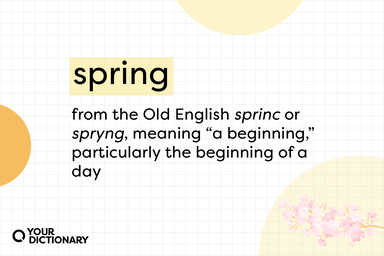
Origin: ME springen < OE springan, akin to Du & Ger springen < IE *sprenĝh-, to move quickly (< base *sper-, to jerk) > Sans spṛhayati, (he) strives for

transitive verb

  1. to cause to leap or come forth suddenly: to spring a covey of quail
  2. Rare to leap over; vault
  3. to cause to close or snap shut, as by a spring: to spring a trap
    1. to cause to warp, bend, strain, split, etc., as by force
    2. to stretch (a spring, etc.) beyond the point where it will spring back fully
  4. to explode (a military mine)
  5. to make known or cause to appear suddenly or unexpectedly: to spring a surprise
  6. Origin: < springthe , sense

    to equip with springs
  7. Slang to get (someone) released from jail or custody, as by paying bail

noun

  1. the act or an instance of springing; specif.,
    1. a jump or leap forward or upward, or the distance covered by this
    2. a sudden darting or flying back
    1. the quality of elasticity; resilience
    2. energy or vigor, as in one's walk
    1. a device, as a coil of wire, that returns to its original form after being forced out of shape: springs are used to absorb shock, and as the motive power in clocks and similar mechanisms
    2. a bedspring or box spring: usually used in pl.
    1. a flow of water from the ground, often a source of a stream, pond, etc.
    2. any source, origin, or motive
    1. that season of the year in which plants begin to grow after lying dormant all winter: in the North Temperate Zone, generally regarded as including the months of March, April, and May: in the astronomical year, that period between the vernal equinox and the summer solstice
    2. any period of beginning or newness
  2. Scot. a lively song or dance
  3. Archit. the line or plane in which an arch or vault rises from its impost
  4. Naut. a split or break in a mast or spar

Origin: ME & OE springe

adjective

  1. of, for, appearing in, or planted in the spring
  2. of or acting like a spring; elastic; resilient
  3. having, or supported on, a spring or springs: a spring mattress
  4. coming from a spring: spring water

See spring in American Heritage Dictionary 4

verb sprang sprang (sprăng) or sprung (sprŭng), sprung sprung, spring·ing, springs
verb, intransitive
  1. To move upward or forward in a single quick motion or a series of such motions; leap.
  2. To move suddenly on or as if on a spring: The door sprang shut. The emergency room team sprang into action.
  3. To appear or come into being quickly: New businesses were springing up rapidly. See Synonyms at stem1.
  4. To issue or emerge suddenly: A cry sprang from her lips. A thought springs to mind.
  5. To extend or curve upward, as an arch.
  6. To arise from a source; develop.
  7. To become warped, split, or cracked. Used of wood.
  8. To move out of place; come loose, as parts of a mechanism.
  9. Slang To pay another's expenses: He offered to spring for the dinner.
verb, transitive
  1. To cause to leap, dart, or come forth suddenly.
  2. To jump over; vault.
  3. To release from a checked or inoperative position; actuate: spring a trap.
  4. a. To cause to warp, split, or crack, as a mast.
    b. To bend by force.
  5. To present or disclose unexpectedly or suddenly: “He sprung on the world this novel approach to political journalism” (Curtis Wilkie).
  6. Slang To cause to be released from prison or other confinement.
noun
  1. An elastic device, such as a coil of wire, that regains its original shape after being compressed or extended.
  2. An actuating force or factor; a motive.
  3. a. Elasticity; resilience.
    b. Energetic bounce: a spring to one's step.
  4. The act or an instance of jumping or leaping.
  5. A usually rapid return to normal shape after removal of stress; recoil.
  6. A small stream of water flowing naturally from the earth.
  7. A source, origin, or beginning.
  8. a. The season of the year, occurring between winter and summer, during which the weather becomes warmer and plants revive, extending in the Northern Hemisphere from the vernal equinox to the summer solstice and popularly considered to comprise March, April, and May.
    b. A time of growth and renewal.
  9. A warping, bending, or cracking, as that caused by excessive force.
  10. Architecture The point at which an arch or vault rises from its support.
adjective
  1. Of or acting like a spring; resilient.
  2. Having or supported by springs: a spring mattress.
  3. a. Of, relating to, occurring in, or appropriate to the season of spring: spring showers; spring planting.
    b. Grown during the season of spring: spring crops.

Origin:

Origin: Middle English springen

Origin: , from Old English springan

Origin: . N., Middle English springe

Origin: , from Old English spring, wellspring

.

Learn more about spring

spring

link/cite print suggestion box