heat

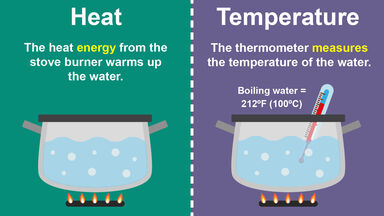
The definition of heat is a form of energy that causes a difference in temperature, or the perception of warmth.

(noun)

An example of heat is hot water.

Heat is defined as to add warmth to something.

(verb)

An example of heat is bringing a kettle of water to a boil.

YourDictionary definition and usage example. Copyright © 2013 by LoveToKnow Corp.

See heat in Webster's New World College Dictionary

noun

  1. the quality of being hot; hotness: in physics, heat is considered a form of energy existing as the result of the random motion of molecules and is the form of energy that is transferred between bodies as a result of their temperature difference
    1. much hotness; great warmth: stifling heat
    2. fever
  2. degree of hotness or warmth: at low heat
  3. the perception of heat by the senses, resulting from contact with or nearness to something hot; sensation of hotness or warmth felt through the skin
  4. hot weather or climate
  5. the warming of a room, house, etc., as by a stove or furnace: his rent includes heat
  6. a burning sensation produced by spices, mustard, etc.
  7. color or other appearance as an indication of hotness: blue heat in metals
  8. strong feeling or emotion; excitement, ardor, anger, zeal, etc.
  9. the period or condition of excitement, intensity, stress, etc.; most violent or intense point or stage: in the heat of battle
  10. a single effort, round, bout, or trial; esp., any of the preliminary rounds of a race, etc., the winners of which compete in the final round
    1. sexual excitement
    2. the period of sexual excitement in animals; esp., the estrus of females
  11. Slang
    1. coercion, as by intimidation
    2. great pressure, as in criminal investigation or law enforcement
    3. the police
    4. a pistol
  12. Baseball, Slang pitches thrown with great velocity
  13. Metallurgy
    1. a single heating of metal, ore, etc. in a furnace or forge
    2. the amount processed in a single heating

Origin: ME hete < OE hætu < base of hat (see hot), akin to Ger heiss < IE base *kai-, heat

transitive verb, intransitive verb

  1. to make or become warm or hot
  2. to make or become excited; inflame or become inflamed

See heat in American Heritage Dictionary 4

noun
Physics
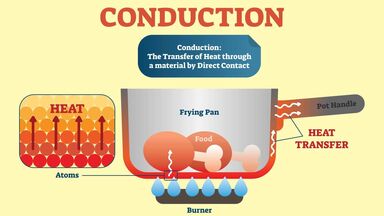
  1. a. A form of energy associated with the motion of atoms or molecules and capable of being transmitted through solid and fluid media by conduction, through fluid media by convection, and through empty space by radiation.
    b. The transfer of energy from one body to another as a result of a difference in temperature or a change in phase.
  2. The sensation or perception of such energy as warmth or hotness.
  3. An abnormally high bodily temperature, as from a fever.
  4. a. The condition of being hot.
    b. A degree of warmth or hotness: The burner was on low heat.
  5. a. The warming of a room or building by a furnace or another source of energy: The house was cheap to rent, but the heat was expensive.
    b. A furnace or other source of warmth in a room or building: The heat was on when we returned from work.
  6. A hot season; a spell of hot weather.
  7. a. Intensity, as of passion, emotion, color, appearance, or effect.
    b. The most intense or active stage: the heat of battle.
    c. A burning sensation in the mouth produced by spicy flavoring in food.
  8. Estrus.
  9. One of a series of efforts or attempts.
  10. a. Sports & Games One round of several in a competition, such as a race.
    b. A preliminary contest held to determine finalists.
  11. Informal Pressure; stress.
  12. Slang
    a. An intensification of police activity in pursuing criminals.
    b. The police. Used with the.
  13. Slang Adverse comments or hostile criticism: Heat from the press forced the senator to resign.
  14. Slang A firearm, especially a pistol.
verb heat·ed, heat·ing, heats
verb, transitive
  1. To make warm or hot.
  2. To excite the feelings of; inflame.
  3. To increase the molecular or kinetic energy of (an object).
verb, intransitive
  1. To become warm or hot.
  2. To become excited emotionally or intellectually.
Phrasal Verb: heat up Informal To become acute or intense: “If inflation heats up, interest rates could increase” (Christian Science Monitor).

Origin:

Origin: Middle English hete

Origin: , from Old English hǣtu; see kai- in Indo-European roots

.

See heat in Ologies

Heat

See also cold; fire

actinism

the ability of light and heat and other forms of radiant energy to cause chemical changes, as hormonal changes in birds causing them to migrate or brood. —actinic, adj.

adiathermancy

imperviousness to radiant heat or infrared radiation. Also called athermancy.

athermancy

adiathermancy.

calorimetry

the science of measuring heat. —calorimeter, n. —calorimetric, adj.

calorist

Rare. one who believed the caloric theory, that heat is a material substance. —caloristic, adj.

galvanothermy

the process of generating heat by means of an electric current.

geothermometry

the branch of geology that measures temperatures deep below the surface of the earth; geologic thermometry.

pyrogenesis

the production or generation of heat. —pyrogenetic, adj.

pyrolysis

the chemical process of decomposition under the effect of heat. —pyrolitic, adj.

pyrophotometer

a type of pyrometer that measures temperature optically or photometrically.

tepidity

a moderate warmth; lukewarmness. —tepid, adj.

thermatology

Medicine. the study of heat as a medical remedy or therapy. Also called thermotherapy.

thermionics

the science or study of the emission of electrons from substances at high temperatures. —thermionic, adj.

thermochemistry

the branch of chemistry that studies the relationship of heat to chemical changes, including the production of energy. —thermochemist, n. —thermochemical, adj.

thermodynamics

the branch of physics that studies the relationship of heat and mechanical energy and the conversion, in various materials, of one into the other. —thermodynamicist, n. —thermodynamic, thermodynamical, adj.

thermogenesis

the production of heat, especially in an animal body by physiological processes. —thermogenic, thermogenous, adj.

thermography

1. Engineering, a method of measuring surf ace temperatures by using luminescent materials.

2. a printing or photocopying process using infrared rays and heat.

3. a process of photography using far-infrared radiation; thermal photography. —thermographer, n. —thermographic, adj.

thermokinematics

the study of the movement of heat. —thermokinematic, adj.

thermology

Archaic. the science and study of heat. Also called thermotics.

thermoluminescence

Atomic Physics. any luminescence appearing in materials upon application of heat, caused by electron movement which increases as the temperature rises. —thermoluminescent, adj.

thermolysis

Physiology. the dispersion of heat from the body. —thermolytic, adj.

thermometry

the branch of physics that deals with the measurement of temperature. —thermometric, adj.

thermophobia

an abnormal fear of heat.

thermoscope

a device for giving an approximation of the temperature change of a substance by noting the accompanying change in its volume. —thermoscopic, adj.

thermostatics

the science or study of the equilibrium of heat.

thermotaxis

1. Biology. the movement of an organism toward or away from a source of heat.

2. Physiology. the regulation of body temperature by various physiological processes. —thermotactic, thermotaxic, adj.

thermotherapy

thermatology.

thermotics

thermology.

transcalency

the property or quality by which matter permits the passage of heat. —transcalent, adj.

Learn more about heat

Related Articles

heat

link/cite print suggestion box