lay

Lay is defined as to put or set something down or to produce and deposit something.

(verb)

  1. An example of lay is to place a plate on the table.
  2. An example of lay is a hen producing eggs.

The definition of lay is the position in which something lies.

(noun)

An example of lay is the way that a plateau is situated on the landscape.

YourDictionary definition and usage example. Copyright © 2013 by LoveToKnow Corp.

See lay in Webster's New World College Dictionary

transitive verb laid, laying

  1. to cause to come down or fall with force; knock down, as from an erect position: a blow laid him low
  2. to cause to lie; place or put so as to be in a resting or recumbent position; deposit: often with on or in: lay the pen on the desk
    1. to put down or place (bricks, carpeting, etc.) in the correct position or way for a specific purpose
    2. to cause to be situated in a particular place or condition: the scene is laid in France
    3. to establish or prepare as a basis or for use: to lay the groundwork
    4. to arrange the fuel in a fireplace for (a fire)
  3. to place; put; set: esp. of something abstract: to lay emphasis on accuracy
  4. to produce and deposit (an egg or eggs)
    1. to cause to subside or settle: lay the dust
    2. to allay, suppress, overcome, or appease: to lay a ghost, lay one's fears
  5. to press or smooth down: to lay the nap of cloth
  6. to bet (a specified sum, etc.)
  7. to impose or place (a tax, penalty, etc. on or upon)
  8. to work out; devise: to lay plans
  9. to prepare (a table) for a meal; set with silverware, plates, etc.
  10. to advance, present, or assert: to lay claim to property, to lay a matter before the voters
  11. to attribute; ascribe; charge; impute: to lay the blame on someone
  12. to arrange and twist together (strands) so as to form (rope, yarn, etc.)
  13. Slang to have sexual intercourse with
  14. Mil. to aim (a gun) by adjusting its direction and elevation

Origin: ME leyen, new formation < 3d pers. sing. of earlier leggen < OE lecgan, lit., to make lie (akin to Goth lagjan, Ger legen) < pt. base of OE licgan, to lie

intransitive verb

  1. to lay an egg or eggs
  2. to bet; wager
  3. to lie; recline: a dialectal or substandard usage
  4. Dialectal to get ready; plan: laying to rob a store
  5. Naut. to go; proceed: all hands, lay aft to the fantail!

noun

  1. the way or position in which something is situated or arranged: the lay of the land
  2. ☆ a share in the profits of some enterprise, esp. of a whaling expedition
  3. the direction or amount of twist of the strands of a rope, cable, etc.
  4. Informal terms of employment, a sale, etc.
  5. Slang
    1. an instance of sexual intercourse
    2. a person regarded as a sexual partner
  6. Chiefly Brit., Slang one's occupation, esp. as a criminal

intransitive verb

lie

adjective

  1. of or consisting of the laity, or ordinary people, as distinguished from the clergy
  2. not belonging to or connected with a given profession; nonprofessional: a legal handbook for lay readers

Origin: ME lai < OFr < LL(Ec) laicus, lay, not priestly < Gr laikos < laos, the people

noun

  1. a short poem, esp. a narrative poem, orig. for singing as by a medieval minstrel
  2. Obsolete a song or melody

Origin: ME lai < OFr < Bret *laid, song, akin to Ir laod

See lay in American Heritage Dictionary 4

verb laid laid (lād), lay·ing, lays
verb, transitive
  1. To cause to lie down: lay a child in its crib.
  2. a. To place in or bring to a particular position: lay the cloth over the painting.
    b. To bury.
  3. To cause to be in a particular condition: The remark laid him open to criticism.
  4. To put or set down: lay new railroad track.
  5. To produce and deposit: lay eggs.
  6. To cause to subside; calm or allay: “chas'd the clouds … and laid the winds” (John Milton).
  7. To put up to or against: lay an ear to the door.
  8. To put forward as a reproach or an accusation: They laid the blame on us.
  9. To put or set in order or readiness for use: lay the table for lunch.
  10. To devise; contrive: lay plans.
  11. To spread over a surface: lay paint on a canvas.
  12. To place or give (importance): lay stress on clarity of expression.
  13. To impose as a burden or punishment: lay a penalty upon the offender.
  14. To present for examination: lay a case before a committee.
  15. To put forward as a demand or an assertion: laid claim to the estate.
  16. Games To place (a bet); wager.
  17. To aim (a gun or cannon).
  18. a. To place together (strands) to be twisted into rope.
    b. To make in this manner: lay up cable.
  19. Vulgar Slang To have sexual intercourse with.
verb, intransitive
  1. To produce and deposit eggs.
  2. To bet; wager.
  3. Nonstandard To lie.
  4. To engage energetically in an action.
  5. Nautical To put oneself into the position indicated.
noun
  1. a. The direction the strands of a rope or cable are twisted in: a left lay.
    b. The amount of such twist.
  2. The state of one that lays eggs: a hen coming into lay.
  3. Vulgar Slang
    a. Sexual intercourse.
    b. A partner in sexual intercourse.
Phrasal Verbs: lay about To strike blows on all sides. lay aside To give up; abandon: lay aside all hope of rescue. To save for the future. lay away To reserve for the future; save. To put aside and hold for future delivery. lay by To save for future use. Nautical To remain stationary while heading into the wind. lay down To give up and surrender: laid down their arms. To specify: laid down the rules. To store for the future. Nonstandard To lie down. lay for Informal To be waiting to attack: Muggers lay for the unsuspecting pedestrian in the dark alley. lay in To store for future use: lay in supplies for an Arctic winter. lay into Slang To scold sharply. To attack physically; beat up. lay off To terminate the employment of (a worker), especially temporarily. To mark off: lay off an area for a garden. Slang To stop doing something; quit. Games To place all or a part of (an accepted bet) with another bookie in order to reduce the risk. lay on To apply (something) by or as if by spreading onto a flat surface: laid on a thick Southern accent. To prepare, usually in an elaborate fashion; arrange: laid on cocktails for 50 at the last minute. Slang To present or reveal to; confront with: “went around talking to people about anything until he could lay his standard question on them” (John Vinocur). lay out To make a detailed plan for. To clothe and prepare (a corpse) for burial. To rebuke harshly: She laid me out for breaking the vase. To knock to the ground or unconscious. To expend; spend: lay out a fortune on jewelry. To display: lay out merchandise; lay the merchandise out. lay over To make a stopover in the course of a journey. lay to Nautical To bring (a ship) to a stop in open water. To remain stationary while heading into the wind. lay up To stock for future use: lay up supplies for a long journey. Informal To confine with an illness or injury: was laid up for a month. Nautical To put (a ship) in dock, as for repairs. Sports To hit a golf shot less far than one is able so as to avoid a hazard.

Origin:

Origin: Middle English leien

Origin: , from Old English lecgan; see legh- in Indo-European roots

.

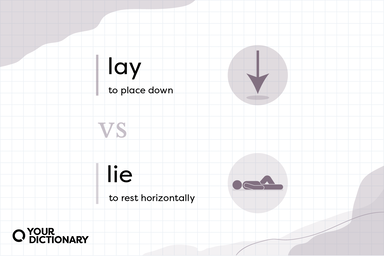
Usage Note: Lay (“to put, place, or prepare”) and lie (“to recline or be situated”) have been confused for centuries; evidence exists that lay has been used to mean “lie” since the 1300s. Why? First, there are two lays. One is the base form of the verb lay, and the other is the past tense of lie. Second, lay was once used with a reflexive pronoun to mean “lie” and survives in the familiar line from the child's prayer Now I lay me down to sleep; lay me down is easily shortened to lay down. Third, lay down, as in She lay down on the sofa sounds the same as laid down, as in I laid down the law to the kids. • Lay and lie are most easily distinguished by usage. Lay is a transitive verb and takes a direct object. Lay and its principal parts (laid, laying) are correctly used in the following examples: He laid (not lay) the newspaper on the table. The table was laid for four. Lie is an intransitive verb and cannot take an object. Lie and its principal parts (lay, lain, lying) are correctly used in the following examples: She often lies (not lays) down after lunch. When I lay (not laid) down, I fell asleep. The rubbish had lain (not laid) there a week. I was lying (not laying) in bed when he called. • There are a few exceptions to these rules. The phrasal verb lay for and the nautical use of lay, as in lay at anchor, though intransitive, are standard.

adjective
  1. Of, relating to, or involving the laity: a lay preacher.
  2. Not of or belonging to a particular profession; nonprofessional: a lay opinion as to the seriousness of the disease.

Origin:

Origin: Middle English

Origin: , from Old French lai

Origin: , from Late Latin lāicus

Origin: , from Greek lāikos, of the people

Origin: , from lāos, the people

.

noun
  1. A narrative poem, such as one sung by medieval minstrels; a ballad.
  2. A song; a tune.

Origin:

Origin: Middle English

Origin: , from Old French lai

.

verb
Past tense of lie1.

Learn more about lay

lay

link/cite print suggestion box