Average Definition
ăvər-ĭj, ăvrĭj
ave, averaged, averages, averaging
noun
averages
A number that typifies a set of numbers of which it is a function.
American Heritage
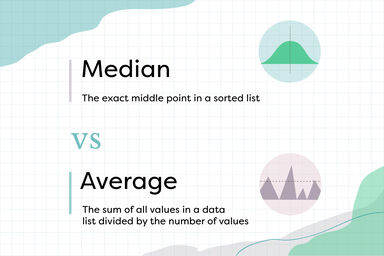
The numerical result obtained by dividing the sum of two or more quantities by the number of quantities; an arithmetic mean.
Webster's New World
An intermediate level or degree.
Near the average in size.
American Heritage
Webster's New World
The usual or ordinary kind or quality.
Although the wines vary, the average is quite good.
American Heritage
Synonyms:
- norm
- run-of-mine
- aggregate
- tally
- percentage
- proportion
- ordinarily
- commonly
- generally
- usually
- common-run
- typical kind
- the usual
- general run
- center
adjective
Of, relating to, or constituting an average.
American Heritage
Constituting an average.
The average speed is high.
Webster's New World
Being intermediate between extremes, as on a scale.
A movie of average length; a player of average ability.
American Heritage
Intermediate in value, rate, etc.; hence, normal or ordinary.
An average student.
Webster's New World
Usual or ordinary in kind or character.
A poll of average people; average eyesight.
American Heritage
Synonyms:
verb
averaged, averages, averaging
To calculate the average of.
Average a set of numbers.
American Heritage
To be or amount to on an average.
The children average six years of age.
Webster's New World
To calculate the average or mean of.
Webster's New World
To do or have an average of.
Averaged three hours of work a day.
American Heritage
To buy or sell additional fixed amounts, as of shares of stock, at lower or higher prices over time so as to get a better average price.
Webster's New World
Synonyms:
- balance
- arrive at an average
- stabilize
- pair-off
- equalize
- equate
- take the average
- compute an average
- split the difference
- reduce to a mean
- strike-a-balance
- average-out
- typical
- standard
- so-so
idiom
average out
- to arrive at an average eventually
Webster's New World
on (the) average
- as an average quantity, rate, etc.
Webster's New World
Other Word Forms of Average
Noun
Singular:
averagePlural:
averagesIdioms, Phrasal Verbs Related to Average
- average out
- on (the) average
Origin of Average
-
Early Modern English damage to a ship or its cargo, equitable distribution of the expenses from such damage, average from Middle English charge above the cost of freight from Old French avarie from Old Italian avaria duty from Arabic ‘awārīya damaged goods from ‘awār blemish from ‘awira to be damaged ʕwr in Semitic roots
From American Heritage Dictionary of the English Language, 5th Edition
From Old French avarie, from Old Italian avaria (which possibly from Arabic عوارية (ʕawārīya, “damaged goods”), from عوار (ʕawār, “fault, blemish, defect, flaw”), from عور (ʕáwira, “to lose an eye”)).
From Wiktionary
Related Articles
Find Similar Words
Find similar words to average using the buttons below.