desert

Desert is defined as to leave or abandon someone or something.

(verb)

  1. An example of desert is a man leaving his pregnant girlfriend.
  2. An example of desert is a military person leaving their post without permission.

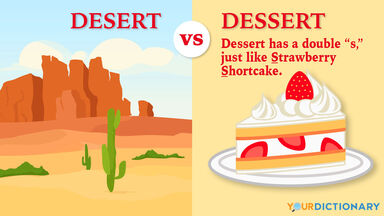
The definition of a desert is a dry, hot, sandy, usually barren and uninhabited area.

(noun)

  1. An example of desert is the Mojave.
  2. An example of desert is Death Valley.

YourDictionary definition and usage example. Copyright © 2013 by LoveToKnow Corp.

See desert in Webster's New World College Dictionary

transitive verb

  1. to forsake (someone or something that one ought not to leave); abandon
  2. to leave (one's post, military service, etc.) without permission
  3. to fail (someone) when most needed

Origin: Fr déserter < LL desertare < desertus, pp. of L deserere, to desert, lit., to disjoin < de-, from + serere, to join < IE base *ser-, to join, place in a row > Gr eirein, to fasten in rows, L series

intransitive verb

to leave one's post, military duty, etc. without permission and with no intent to return, or, in war, in order to avoid hazardous duty

Related Forms:

noun

  1. an uncultivated region without inhabitants; wilderness
  2. a dry, barren, sandy region, often extremely hot

Origin: ME < OFr < LL(Ec) desertum, a desert, for L deserta < desertus: see desert

adjective

  1. of a desert or deserts
  2. wild and uninhabited: a desert island

noun

  1. the fact of deserving reward or punishment
  2. deserved reward or punishment: to get one's just deserts
  3. the quality of deserving reward; merit

Origin: ME & OFr deserte < deservir: see deserve

See desert in American Heritage Dictionary 4

noun
  1. A barren or desolate area, especially:
    a. A dry, often sandy region of little rainfall, extreme temperatures, and sparse vegetation.
    b. A region of permanent cold that is largely or entirely devoid of life.
    c. An apparently lifeless area of water.
  2. An empty or forsaken place; a wasteland: a cultural desert.
  3. Archaic A wild, uncultivated, and uninhabited region.
adjective
  1. Of, relating to, characteristic of, or inhabiting a desert: desert fauna.
  2. Barren and uninhabited; desolate: a desert island.

Origin:

Origin: Middle English

Origin: , from Old French

Origin: , from Late Latin dēsertum

Origin: , from

Origin: neuter past participle of dēserere, to desert; see desert3

.

noun
  1. Something that is deserved or merited, especially a punishment. Often used in the plural: They got their just deserts when the scheme was finally uncovered.
  2. The state or fact of deserving reward or punishment.

Origin:

Origin: Middle English

Origin: , from Old French deserte

Origin: , from

Origin: feminine past participle of deservir, to deserve; see deserve

.

Word History: When Shakespeare says in Sonnet 72, “Unless you would devise some virtuous lie,/To do more for me than mine own desert,” he is using the word desert in the sense of “worthiness; deserving,” a word perhaps most familiar to us in the plural, meaning “something that is deserved,” as in the phrase just deserts. This word goes back to the Latin word dēservīre, “to devote oneself to the service of,” which in Vulgar Latin came to mean “to merit by service.” Dēservīre is made up of dē-, meaning “thoroughly,” and servīre, “to serve.” Knowing this, we can distinguish this desert from desert, “a wasteland,” and desert, “to abandon,” both of which go back to Latin dēserere, “to forsake, leave uninhabited,” which is made up of dē-, expressing the notion of undoing, and the verb serere, “to link together.” We can also distinguish all three deserts from dessert, “a sweet course at the end of a meal,” which is from the French word desservir, “to clear the table.” Desservir is made up of des-, expressing the notion of reversal, and servir (from Latin servīre), “to serve,” hence, “to unserve” or “to clear the table.”

verb de·sert·ed, de·sert·ing, de·serts
verb, transitive
  1. To leave empty or alone; abandon.
  2. To withdraw from, especially in spite of a responsibility or duty; forsake: deserted her friend in a time of need.
  3. To abandon (a military post, for example) in violation of orders or an oath.
verb, intransitive
To forsake one's duty or post, especially to be absent without leave from the armed forces with no intention of returning.

Origin:

Origin: French déserter

Origin: , from Late Latin dēsertāre

Origin: , frequentative of Latin dēserere, to abandon

Origin: : dē-, de-

Origin: + serere, to join; see ser-2 in Indo-European roots

.

Related Forms:

  • de·sertˈer noun

Learn more about desert

Related Articles

link/cite print suggestion box