ocean

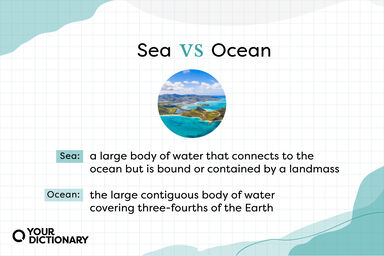
Ocean is defined as the body of salt water covering much of the Earth or a large quantity of something.

Facts About Oceans

  • The five oceans cover about 70% of the Earth’s surface.
  • Pacific Ocean - The average depth of the Pacific Ocean is 15,215 feet. The deepest point, which is the deepest point of all oceans, is the Mariana Trench. This trench, located near Japan, goes to depths of 36,200 feet and is the lowest elevation on the surface of the Earth.
  • Atlantic Ocean - The bottom of the Atlantic Ocean is generally measured at 12,881 feet. The deepest point here is the Puerto Rico Trench at 28,231 feet. The Atlantic Ocean is the saltiest of the oceans, ranging from 33 parts per thousand to 37 parts per thousand.
  • Indian Ocean - The Indian Ocean sees average depths of 13,002 feet. Their deepest point is the Java Trench, which is 25,344 feet.
  • Southern Ocean - The average depths in the Southern Ocean greatly vary. On the low end, they are 13,100 feet and on the high end they are 16,400 feet deep. The deepest point is the southern end of the South Sandwich Trench, measuring 23,736 feet deep.
  • Arctic Ocean - The Arctic Ocean is so much more shallow than the other ones at average depths of only 3,953 feet. The deepest point is the Eurasian Basin, which is 17,881 feet deep.
  • The ocean with the greatest salt content is the Atlantic Ocean with between 3.3 and 3.7% salinity. The Pacific Ocean has 3.2 to 3.4% salinity. The Indian Ocean salinity ranges from 3.2 to 3.7%. The Arctic Ocean is the least salty because polar oceans are usually less salty than others because of low evaporation, freshwater from rivers, and little connection to other oceans.
  • There are three theories of why the oceans appear blue:
  • The ocean reflects the sky which is blue.
  • Plant and animal life and particles in the water help reflect the color blue.
  • The observer’s eye absorbs only a minimal amount of scattered blue wavelengths, and this is what is reflected back to the eye.
(noun)

  1. An example of an ocean is the Atlantic.
  2. An example of an ocean is a great amount of food at a buffet.

YourDictionary definition and usage example. Copyright © 2013 by LoveToKnow Corp.

See ocean in Webster's New World College Dictionary

noun

  1. the great body of salt water that covers approximately 71% of the surface of the earth
  2. any of its four principal geographical divisions: the Atlantic, Pacific, Indian, or Arctic Ocean
  3. any great expanse or quantity

Origin: ME occean < OFr < L Oceanus < Gr Ōkeanos, the outer sea (in contrast to the Mediterranean), orig. thought of as a great river flowing around the earth

See ocean in American Heritage Dictionary 4

noun
  1. The entire body of salt water that covers more than 70 percent of the earth's surface.
  2. Abbr. Oc. or O. Any of the principal divisions of the ocean, including the Atlantic, Pacific, Indian, Arctic, and Antarctic oceans.
  3. A great expanse or amount: “that ocean of land which is Russia” (Henry A. Kissinger).

Origin:

Origin: Middle English occean

Origin: , from Old French

Origin: , from Latin ōceanus

Origin: , from Greek Ōkeanos, the god Oceanus, a great river encircling the earth

.

Learn more about ocean

Related Articles

ocean

link/cite print suggestion box