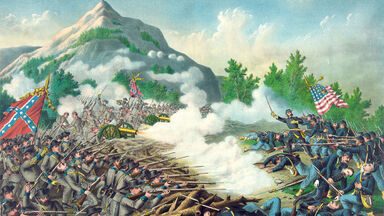
War is an armed conflict within a country or between countries.
(noun)An example of a war is the conflict between the United States and Iraq.
See war in Webster's New World College Dictionary
noun
Origin: ME werre < NormFr < Frank *werra, confusion, strife, akin ? to OHG (fir)werran, to confuse < ?
adjective
adjective, adverb
Origin: ME < ON verre, adj., verr, adv.; akin to OHG werran, to confuse
See war in American Heritage Dictionary 4
noun
Origin:
Origin: Middle English warre
Origin: , from Old North French werre
Origin: , of Germanic origin; see wers- in Indo-European roots
. Word History: The chaos of war is reflected in the semantic history of the word war. War can be traced back to the Indo-European root *wers-, “to confuse, mix up.” In the Germanic family of the Indo-European languages, this root gave rise to several words having to do with confusion or mixture of various kinds. One was the noun *werza-, “confusion,” which in a later form *werra- was borrowed into Old French, probably from Frankish, a largely unrecorded Germanic language that contributed about 200 words to the vocabulary of Old French. From the Germanic stem came both the form werre in Old North French, the form borrowed into English in the 12th century, and guerre (the source of guerrilla) in the rest of the Old French-speaking area. Both forms meant “war.” Meanwhile another form derived from the same Indo-European root had developed into a word denoting a more benign kind of mixture, Old High German wurst, meaning “sausage.” Modern German Wurst was borrowed into English in the 19th century, first by itself (recorded in 1855) and then as part of the word liverwurst (1869), the liver being a translation of German Leber in Leberwurst.See war in Ologies
War
See also conflict; killing; weaponry.
the right of a nation at war to destroy the property of a neutral, subject to indemnification.
antiterrorism
the techniques, policies, and training of special police who deal with terrorists, especially those who take hostages. —antiterrorist, adj.
a temporary cessation of hostilities, by agreement between the belligerents, prior to the negotiation or signing of a peace treaty.
bellicism
the advocacy of war. Cf. pacifism. —bellicist, n.
the state of being hostile or at war. —belligerent, n., adj.
copperheadism
any expression of sympathy for the Confederate cause in the American Civil War. —copperhead, n.
the process of demilitarization or removal of military activity or control from an area.
the process of being demobilized or mustered out of the military.
the reduction in size of military forces, by treaty, following defeat, etc. Also Obsolete, disarmature.
disarmature
Obsolete. disarmament.
doveism, dovism
the advocacy of peace or a conciliatory national attitude, especially on the part of a public official. Cf. hawkism. —dove, n. —doveish, adj.
1. a war between giants, as in mythology.
2. war between large contestants, as major powers.
guerrillaism
the practice and philosophy of guerrilla warfare.
hawkism
the advocacy of war or a belligerent national attitude, especially on the part of a public official. Cf. doveism. —hawk, n. —hawkish, adj.
1. a feeling or state of antagonism.
2. an expression or act of war. —hostile, adj.
insurgency.
1. the state or condition of being in revolt or insurrection.
2. an uprising. —insurgent, n., adj.
irenicism
an advocacy of peace and conciliation. —irenicist, n.
the branch of military science concerned with the movement and supply of troops. —logistician, n.
1. an inclination to belligerency; bellicosity.
2. the qualities of a military existence. —martialist, n.
1. the state or condition of being combative or disposed to fight.
2. the active championing of a cause or belief. —militant, n., adj.
the process of preparing for war; mobilization of troops or of an area.
monomachy, monomachia
single combat, or a duel. —monomachist, n.
1. a mock sea fight, as in ancient Rome.
2. the flooded arena where such fights were conducted.
navalism
the maintaining of naval interests. —navalist, n.
the state or position of being impartial or not allied with or committed to either party or viewpoint in a conflict, especially a war or armed conflict, —neutral, adj.
1. an opposition to war or violence of any kind.
2. the principle or policy of establishing and maintaining universal peace.
3. nonresistance to aggression. Cf. bellicism. —pacifist, n. —pacifistic, adj.
1. the act of plundering or large scale robbery, usually accompanied by violence as in wartime.
2. plundered property; booty.
poliorcetics
the art of siegecraft. —poliorcetic, adj.
destruction of or damage to equipment, installations, etc, in an industrial context, as in a labor dispute, or in a military context, as in the action of partisan or resistance movements. —saboteur, n.
siegecraft
the science or craft of laying or carrying out sieges.
soldiership or military science or craft.
the process of robbing or plundering, especially in time of war and on a large scale. See also church; ships.
stratography
the art of directing an army. —stratographer, n.
a person skilled in the art of tactics, in a military or other sense.
1. the art or science of disposing or managing military forces to best advantage against the enemy.
2. a skill or resource management in other contexts.
battle between Titans, referring to the unsuccessful revolt of the family of Iapetus against Zeus.
an ancient Athenian policy allowing private citizens, as part of their civic duty, to fit out triremes for the defense of the city.
warcraft
the science, art, or craft of war.
Learn more about war