negative

The definition of negative is something that refuses or denies, a person or thing that is not positive, or the opposite of a positive electrical charge.

(adjective)

  1. An example of negative is someone giving a "no" response to a party invitation.
  2. An example of negative is a person with a "glass is half empty" view on life.
  3. An example of negative is an electrical charge that is attracted to a positive charge.

A negative is defined as a person or thing that refuses or denies, or is undesirable, unwanted or disliked.

(noun)

  1. An example of a negative is the "no" response given by a person.
  2. An example of a negative is a cab driver who gets lost all the time.

A negative is defined as the reverse impression of something.

(noun)

An example of a negative is the film strip that gets returned with photos printed from a 35mm film camera.

YourDictionary definition and usage example. Copyright © 2013 by LoveToKnow Corp.

See negative in Webster's New World College Dictionary

adjective

  1. containing, expressing, or implying a denial or refusal; that says “no”: a negative reply
  2. opposite to something regarded as positive; specif.,
    1. lacking in positive character or quality
    2. lacking evidence, affirmation, etc.
    3. having the effect of diminishing, depriving, or denying
    4. faultfinding, antagonistic, destructive, etc.: negative criticism, a negative political campaign
  3. Biol. directed away from the source of a stimulus: negative tropism
  4. Elec.
    1. of, generating, or charged with negative electricity
    2. having an excess of electrons
  5. Logic denying something about a subject: “no reptiles are warmblooded” is a negative proposition
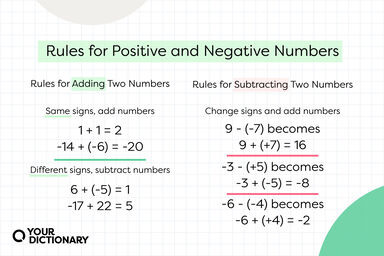
  6. Math. designating a quantity less than zero, or one to be subtracted; minus quantity
  7. Med. not having or not demonstrating, showing, or proving the presence or existence of a condition, infection, symptoms, bacteria, etc.: a patient who is negative for TB; the X-rays were negative
  8. Photog. reversing the relation of light and shade of the subject

Origin: ME negatife < OFr or L: OFr négatif < L negativus < negatus: see negation

adverb, interjection

no; not so: so used in radio communication

noun

  1. a word, affix, phrase, etc. that denies, rejects, or refuses (Ex.: no, not, by no means)
  2. a statement of denial, refusal, or rejection
  3. the point of view that denies or attacks the positive or affirmative: the negative won the debate
  4. an undesirable element or quality; drawback, shortcoming, defect, etc.
  5. an impression of something, as a sculpture, that shows it in reverse
  6. Obsolete the right of veto
  7. Elec. a terminal, electrode, or plate having an excess of electrons flowing out toward a positive terminal, electrode, or plate, as in a storage battery or dry cell
  8. Math. a quantity less than zero, or one to be subtracted; minus quantity
  9. Photog. an exposed and developed photographic film or plate on which light and shadow are the reverse of what they are in the positive printed from this

transitive verb negatived, negativing

    1. to refuse; reject
    2. ☆ to veto (a candidate, motion, or bill)
  1. to deny; contradict
  2. to prove false; disprove
  3. to counteract; neutralize

interjection

no!not so!

Related Forms:

See negative in American Heritage Dictionary 4

adjective
  1. a. Expressing, containing, or consisting of a negation, refusal, or denial: gave a negative answer to our request.
    b. Indicating opposition or resistance: a negative reaction to the new advertising campaign.
  2. Lacking positive or constructive features, especially:
    a. Unpleasant; disagreeable: had a negative experience on his first job.
    b. Gloomy; pessimistic: a negative outlook.
    c. Unfavorable or detrimental: a negative review; a negative effect on the child's development.
    d. Hostile or disparaging; malicious: ran a negative campaign against her opponent.
  3. Medicine Not indicating the presence of a particular disease, condition, or organism.
  4. Logic Designating a proposition that denies agreement between a subject and its predicate.
  5. Mathematics
    a. Of or relating to a quantity less than zero.
    b. Of or relating to the sign (-).
    c. Of or relating to a quantity to be subtracted from another.
    d. Of or relating to a quantity, number, angle, velocity, or direction in a sense opposite to another of the same magnitude indicated or understood to be positive.
  6. Physics
    a. Of or relating to an electric charge of the same sign as that of an electron, indicated by the symbol (-).
    b. Of or relating to a body having an excess of electrons.
  7. Chemistry Of or relating to an ion, the anion, that is attracted to a positive electrode.
  8. Biology Moving or turning away from a stimulus, such as light: a negative tropism.
noun
  1. A statement or act indicating or expressing a contradiction, denial, or refusal.
  2. a. A statement or act that is highly critical of another or of others: campaign advertising that was based solely on negatives.
    b. Something that lacks all positive, affirmative, or encouraging features; an element that is the counterpoint of the positive: “Life is full of overwhelming odds. You can't really eliminate the negatives but you can diminish them” (Art Linkletter).
    c. A feature or characteristic that is not deemed positive, affirmative, or desirable: “As voters get to know his liberal views, his negatives will rise” (Richard M. Nixon).
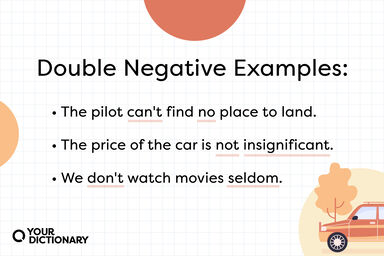
  3. Grammar A word or part of a word, such as no, not, or non-, that indicates negation. See Usage Note at double negative.
  4. The side in a debate that contradicts or opposes the question being debated.
  5. a. An image in which the light areas of the object rendered appear dark and the dark areas appear light.
    b. A film, plate, or other photographic material containing such an image.
  6. Mathematics A negative quantity.
transitive verb neg·a·tived, neg·a·tiv·ing, neg·a·tives
  1. To refuse to approve; veto.
  2. To deny; contradict.
  3. To demonstrate to be false; disprove.
  4. To counteract or neutralize.

Origin:

Origin: Middle English

Origin: , from Old French negatif

Origin: , from Latin negātīvus

Origin: , from negātus

Origin: , past participle of negāre, to deny; see negate

.

Related Forms:

  • negˈa·tive·ly adverb
  • negˈa·tive·ness, negˌa·tivˈi·ty (-tĭvˈĭ-tē) noun

Learn more about negative

link/cite print suggestion box