mold

Mold is a form or a container used to give shape to something.

(noun)

An example of a mold is a container into which you pour soft Jello so it will assume the specific shape of the container.

Mold is defined as a growth of fungus that occurs on food or in a home or other moist warm conditions.

(noun)

An example of mold is a fungus that has grown on bread left in a damp environment.

YourDictionary definition and usage example. Copyright © 2013 by LoveToKnow Corp.

See mold in Webster's New World College Dictionary

noun

  1. a pattern, hollow form, or matrix for giving a certain shape to something in a plastic or molten state
  2. a frame, shaped core, etc. on or around which something is modeled
  3. a pattern after which something is formed; model
  4. something formed or shaped in or on, or as if in or on, a mold; often, specif., a gelatin dessert, aspic, etc. so prepared
    1. the form or shape given by a mold
    2. form or shape in general
  5. distinctive character or nature: men of his mold
  6. Archit. a molding or group of moldings

Origin: ME moolde < OFr molle, earlier modle < L modulus: see module

transitive verb

  1. to make or shape in or on, or as if in or on, a mold
  2. to work into a certain form or shape; shape
  3. to have a strong or important influence on (public opinion, thought, etc.)
  4. to fit closely to the outline or contours of
  5. to ornament by or with molding
  6. to make a mold of or from in order to make a casting

Related Forms:

noun

  1. a downy or furry growth on the surface of organic matter, caused by fungi, esp. in the presence of dampness or decay
  2. any fungus producing such a growth
  3. any plant disease, as snowmold, caused by such fungus

Origin: ME moul, mowlde, mold, mildew < or akin to ON mygla < IE base *meug-, *meuk-: see meek; sp. prob. infl. by mold

transitive verb, intransitive verb

to make or become moldy

Origin: < ME moulen (with unhistoric -d-

noun

  1. loose, soft, easily worked soil, esp. when rich with decayed animal or vegetable matter and good for growing plants
  2. Archaic earth or ground

Origin: ME mold < OE molde, dust, ground, earth, akin to Goth mulda < IE base *mel-, to rub away, grind > L molere, to grind, mill

See mold in American Heritage Dictionary 4

noun
  1. A hollow form or matrix for shaping a fluid or plastic substance.
  2. A frame or model around or on which something is formed or shaped.
  3. Something that is made in or shaped on a mold.
  4. The shape or pattern of a mold.
  5. General shape or form: the oval mold of her face.
  6. Distinctive character or type: a leader in the mold of her predecessors.
  7. A fixed or restrictive pattern or form: a method of scientific investigation that broke the mold and led to a new discovery.
  8. Architecture See molding.
verb mold·ed, mold·ing, molds
verb, transitive
  1. To shape in or on a mold.
  2. a. To form into a particular shape; give shape to.
    b. To guide or determine the growth or development of; influence: a teacher who helps to mold the minds of his students.
  3. To fit closely by following the contours of.
  4. To make a mold of or from (molten metal, for example) before casting.
  5. To ornament with moldings.
verb, intransitive
To be shaped in or as if in a mold: shoes that gradually molded to my feet.

Origin:

Origin: Middle English molde

Origin: , from Old French modle, molle

Origin: , from Latin modulus

Origin: , diminutive of modus, measure; see med- in Indo-European roots

.

Related Forms:

  • moldˈa·ble adjective
  • moldˈer noun

noun
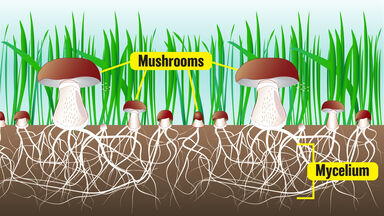
  1. Any of various fungi that often cause disintegration of organic matter.
  2. The growth of such fungi.
intransitive verb mold·ed, mold·ing, molds
To become moldy.

Origin:

Origin: Middle English moulde

Origin: , probably from past participle of moulen, to grow moldy

Origin: , from Old Norse mygla

.

noun
  1. Loose friable soil, rich in humus and fit for planting.
  2. Chiefly British
    a. The earth; the ground.
    b. The earth of the grave.
  3. Archaic Earth as the substance of the human body.

Origin:

Origin: Middle English

Origin: , from Old English molde; see melə- in Indo-European roots

.

Learn more about mold

mold

link/cite print suggestion box