parasite
para·site (par′ə sīt′)
noun
- a person, as in ancient Greece, who flattered and amused the host in return for free meals
- a person who lives at the expense of another or others without making any useful contribution or return; hanger-on
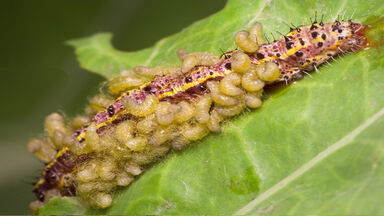
- Biol. a plant or animal that lives on or in an organism of another species from which it derives sustenance or protection without benefit to, and usually with harmful effects on, the host
Etymology: L parasitus < Gr parasitos, one who eats at the table of another, parasite, toady < para-, beside (see para-) + sitos, food, grain
parasite
n.
A plant or animal living on another
bacteria, parasitoid, saprophyte, epiphyte; see fungus.A hanger-on
dependent, slave, sponge, freeloader, hanger-on, sponger; see also sycophant.
Converse of subject
- infect: From the moment Michael Rooker's town bully becomes infected by the parasite, it's a messy thrill-ride of increasingly grotesque adventures.
Converse of object
- single-cel: In order to cause the disease, the single-celled parasite must multiply in the human bloodstream.
Adjective modifier
- protozoan: Protozoan parasites in the UK - cause for concern?
- malarial: Funding: Monkey malaria 13 March 2006 Researchers in Malaysia are aiming to discover whether malarial parasites are being transmitted from monkeys to humans.
- obligate: Their replication strategy like that of viruses - they are obligate intracellular parasites.
- intestinal: There are two main types of intestinal parasites.. .
- apicomplexan: The disease results from replication in red blood cells of apicomplexan parasites belonging to the genus Plasmodium.
- intracellular: It also plays a role in the immune system, apparently helping control infection by intracellular parasites.
Modifies a noun
- plasmodium: They describe the life cycle of the mosquito parasite Plasmodium.
- falciparum: Research The research carried out in David's group is focused on the sexual stages of the human malaria parasite Plasmodium falciparum.
- phylogeny: Error in phylogeny will be illustrated with a comparison of two contemporary primate or host phylogenies against the pinworm or parasite phylogeny.
- infestation: It also allows the squirrel to reduce the level of parasite infestation they suffer by leaving parasites behind in the nest.
- virulence: Parasite virulence is a powerful concept that dynamically changes in natural systems when necessary.
- cryptosporidium: Cryptosporidiosis is a type of gastroenteritis caused by the parasite Cryptosporidium which lives in the bowel.
Noun used with modifier
- malaria: Malaria parasite antigens exposed on the surface of the infected red blood cell membrane.
- helminth: The molecular biology of helminth parasites ( worms ) is also under study in 3IR.
- plasmodium: To address this aspect we study the interactions of Anopheles mosquitoes and Plasmodium parasites, the agent of malignant malaria.
- nematode: Shared nematode parasite is developing in Pheasant much better than in Partridge, but has much greater effect on the later.
- brood: It involves experiments in the laboratory as well as field work on brood parasites in Australia and America.
- gut: Gut parasites are of great importance in birds of prey.
I am proud that I am an Australian, a daughter of the Southern Cross, a child of the mighty bush. I am thankful I am a peasant, a part of the bone and muscle of my nation, and earn my bread by the sweat of my brow, as man was meant to do. I rejoice I was not born a parasite, one of the blood-suckers who loll on velvet and satin, crushed from the proceeds of human sweat and blood and souls.
Browse dictionary entries near parasite
- parashah
- parasexual
- paraselene
- parasang
- parasail
- pararosaniline
- pararescue
- paraquat
- parapsychology
- paraprofessional
- parasite drag
- parasitic
- parasitical
- parasiticide
- parasitism
- parasitize
- parasitoid
- parasitology
- parasitosis
- parasol