weather

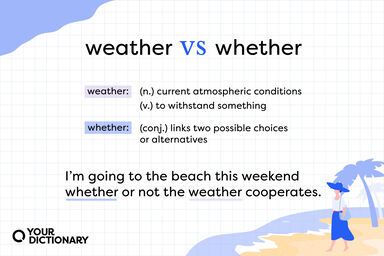
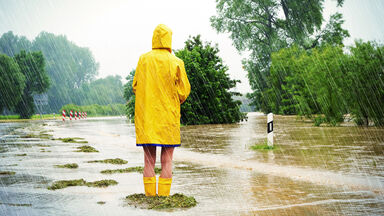
Weather is the condition of the climate in a particular place at a particular time.

(noun)

  1. An example of weather is San Diego being sunny in January.
  2. An example of weather is Florida having hurricanes in September.

Weather means to be affected by climate.

(verb)

An example of weather is the Statue of Liberty turning green from the reaction of copper and rain.

Weather is defined as to get through a situation or event positively.

(verb)

An example of weather is someone getting into an accident without injury or damage to their car.

YourDictionary definition and usage example. Copyright © 2013 by LoveToKnow Corp.

See weather in Webster's New World College Dictionary

noun

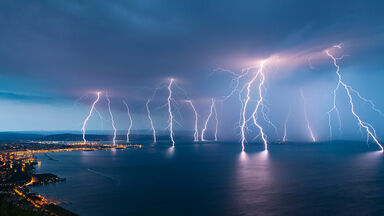
  1. the general condition of the atmosphere at a particular time and place, with regard to the temperature, moisture, cloudiness, etc.
  2. disagreeable or harmful atmospheric conditions; storm, rain, etc.: protected against the weather

Origin: ME weder < OE, akin to ON vethr, Ger wetter < IE base *we-, *awe-, to blow > wind, OSlav vedro, fair weather

transitive verb

  1. to expose to the action of weather or atmosphere, as for airing, drying or seasoning
  2. to wear away, discolor, disintegrate, or otherwise change for the worse by exposure to the atmosphere
  3. to pass through safely or survive: to weather a storm
  4. to slope (masonry, cornices, sills, etc.) so as to allow water to run off
  5. Naut. to pass to the windward of (a cape, reef, etc.)

intransitive verb

  1. to become discolored, disintegrated, etc. by exposure to the weather or atmosphere
  2. to endure such exposure in a specified manner: canvas that weathers well

adjective

  1. designating or of the side of a ship, etc. toward the wind; windward
  2. exposed to the elements: weather deck

See weather in American Heritage Dictionary 4

noun
  1. The state of the atmosphere at a given time and place, with respect to variables such as temperature, moisture, wind velocity, and barometric pressure.
  2. a. Adverse or destructive atmospheric conditions, such as high winds or heavy rain: encountered weather five miles out to sea.
    b. The unpleasant or destructive effects of such atmospheric conditions: protected the house from the weather.
  3. weathers Changes of fortune: had known him in many weathers.
verb weath·ered, weath·er·ing, weath·ers
verb, transitive
  1. To expose to the action of the elements, as for drying, seasoning, or coloring.
  2. To discolor, disintegrate, wear, or otherwise affect adversely by exposure.
  3. To come through (something) safely; survive: weather a crisis.
  4. To slope (a roof, for example) so as to shed water.
  5. Nautical To pass to the windward of despite bad weather.
verb, intransitive
  1. To show the effects, such as discoloration, of exposure to the elements: The walls of the barn had weathered.
  2. To withstand the effects of weather: a house paint that weathers well.
adjective
  1. Nautical Of or relating to the windward side of a ship; windward.
  2. Relating to or used in weather forecasting: a weather plane.
Phrasal Verb: weather in To experience or cause to experience weather conditions that prevent movement: The squadron is weathered in because of dense fog. Such a storm will weather the fleet in.

Origin:

Origin: Middle English weder, wether

Origin: , from Old English weder; see wē- in Indo-European roots

.

See weather in Ologies

Weather

See also atmosphere; climate; clouds; lightning; rain; snow; sun; thunder; wind

aerographics

the study of atmospheric conditions. Also aerography. —aerographer, n.

aerology

1. Obsolete. the branch of meteorology that observed the atmosphere by using balloons, airplanes, etc.

2. meteorology. —aerologist, n.aerologic, aerological, adj.

aeromancy

1. the art or science of divination by means of the air or winds.

2. Humorous weather forecasting.

barograph

a barometer which automatically records, on a rotating cylinder, any variation in atmospheric pressure; a self-recording aneroid.

barometrography

the branch of science that deals with the barometer.

barometry

the art or science of barometric observation.

chonophobia

an abnormal fear or dislike of snow.

climatology

the science that studies climate or climatic conditions. —climatologist, n.climatologic, climatological, adj.

cryophobia

an abnormal fear of ice or frost.

frontogenesis

the meeting of two masses of air, each with a different meteorological composition, thus forming a front, sometimes resulting in rain, snow, etc.

frontolysis

the process by which a meteorological front is destroyed, as by mixture or deflection of the frontal air.

homichlophobia

an abnormal fear of fog.

hyetology

Rare. the branch of meteorology that studies rainfall. —hyetologist, n.hyetological, adj.

hyetophobia

an abnormal dislike or fear of rain.

hytherograph

a graph that shows the relationship between temperature and either humidity or precipitation.

irroration

Obsolete. 1. the process of moistening with dew.

2. the condition of being bedewed.

meteorology

the study of weather and its changes, especially with the aim of predicting it accurately. —meteorologist, n.meteorologie, meteorological, adj.

microbarograph

a barograph for recording small fluctuations of atmospheric pressure.

nephology

the scientific study of clouds. —nephologist, n.

ombrology

the branch of meteorology that studies rain. —ombrological, n.

pluviography

the branch of meteorology that automatically measures rainf all and snowfall. —pluviographic, pluviographical, adj.

pluviometry

the branch of meteorology concerned with the measurement of rainf all. —pluviometric, pluviometrical, adj.

pluvioscope

an instrument for measuring rainfall; a rain gauge.

pluviosity

raininess. —pluvious, adj.

telemeteorography

the recording of meteorological conditions at a distance, as in the use of sensing devices at various points that transmit their data to a central office. —telemeteorographic, n.

udometry

the measurement of rainfall with any of various types of rain gauges. —udometric, adj.

udomograph

a self-registering rain gauge.

vacuometer

an instrument used for comparing barometers at varying pressures against a Standard barometer.

weatherology

Informal. meteorology, especially weather forecasts for radio or television.

Learn more about weather

Related Articles

weather

link/cite print suggestion box