The definition of hurricane is a storm with winds of 74 mph or more.
Facts About Hurricanes
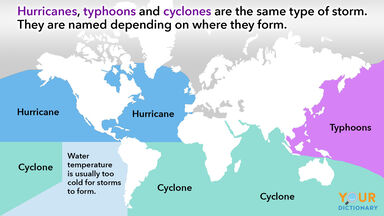
- Hurricanes are tropical cyclones that form over the warm, humid air near the equator in the Atlantic Ocean and the Caribbean.
- U.S. hurricane season is defined as June 1st to November 30th of each year, with the peak in September. The Atlantic coast peak is a bit earlier in the season, mainly between mid-August through mid-September.
- A hurricane needs a surface water temperature of at least 79 degrees Fahrenheit to warm the air at the ocean surface which then rises up, taking water in the form of vapor with it.
- A low-pressure system will cause the clouds to rapidly circle counterclockwise (in the Northern Hemisphere) or clockwise (in the Southern Hemisphere). An eye will form in the center.
- Converging winds at the ocean's surface collide pushing even more water vapor upwards, increasing warm air circulation and the wind speeds.
- High pressure air at high altitudes pull even more heat away from the center of the storm, cooling the rising air resulting in further condensation and causing a faster release of heat energy. The high pressure air is pulled into the low-pressure center increasing the wind speeds.
- Hurricanes make landfall between the Gulf of Mexico coast and the Florida peninsula.
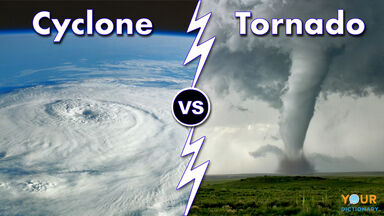
- When a hurricane hits the ground, the bottom part of the hurricane slows down. The top part picks up even more speed and momentum and a tornado can form.
- A hurricane can form quickly within six hours, or it can take as long as 10 days.
- A hurricane’s winds range from 74 mph and can exceed 155 mph, carry six to 12 inches of rainfall and bring storm surges near the coast.
- Most Atlantic hurricanes average nine days but the hurricanes that form in August average 12 days.
- Hurricanes can form tornadoes thousands of miles away from the original point of storm impact.
- A storm is classified a hurricane when the winds reach a speed of 74 mph. After that point, a hurricane is categorized according to the Saffir-Simpson Hurricane Scale:
- Category 1, winds 74-95, minimal damage and flooding, 4-5 foot storm surge
- Category 2, winds 96-110, moderate damage to buildings, more damage to vegetation, flooding, 6-8 foot storm surge
- Category 3, winds 111-130, extensive damage to buildings, mobile homes destroyed, extensive flooding, 9-12 foot storm surge
- Category 4, winds 131-155, extreme damage to buildings, erosion of beach, massive flooding, 13-18 foot storm surge
- Category 5, winds more than 155, catastrophic damage with complete roof or building destruction, extreme flooding, over 18 foot storm surge
- Hurricanes are tracked with satellite pictures, rainfall measurements, 3-D measurements, windspeed measurements.
Major Hurricane Tracks
- East Pacific - Hurricane paths tend to gather near the western side of Central America.
- West Pacific - Hurricanes are located near either the Chinese mainland or the islands right off the shore.
- South Pacific - Hurricanes often take a path over land.
(noun)An example of a hurricane is the storm Katrina that hit New Orleans in 2005.
Hurricane is defined as something that is as strong as a devastating storm.
(noun)An example of Hurricane is the nickname for a famous boxer.