typhoon

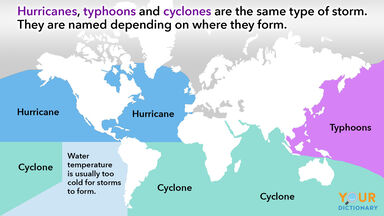
The definition of a typhoon is a tropical cyclone with winds faster than 74 miles per hour that occurs in the North Atlantic Ocean, the Northeast Pacific Ocean east of the dateline, the South Pacific east of 160E and the Northwest Pacific Ocean west of the date line.

Facts About Typhoons

Rating Scale
  • Once a tropical storm has reached sustained winds of 73 miles per hour or 64 knots per hour, the storm is classified a typhoon.
  • After that, there are only two divisions: severe typhoon and super typhoon.
  • A severe typhoon has sustained winds of at least 95 miles per hour or 80 knots and a super typhoon has sustained winds of at least 115 miles per hour or 100 knots.
Formation
  • Typhoons begin over warm water and in humid air between 10 and 20 degrees latitude north in the Pacific Ocean.
  • As warm air rises from the surface of the water, less air is left and a low pressure area develops.
  • This area of low pressure pulls in the air around it.
  • As the air comes in, it warms up and begins to rise.
  • Clouds begin to form as the air cools because of its elevation and soon the system begins to rotate.
  • If conditions are favorable, especially the temperature of the water, then the system grows and eventually an eye will form.
  • If the water temperature drops below 79 degrees Fahrenheit, the storm will weaken.
  • The typhoon will also dissipate if it moves over land.
Geography and Climate
  • Some of the countries that experience typhoons: Guam, Marianas Islands, Philippines, Taiwan, southern China, South Korea, southern Japan and Vietnam.
  • Before a typhoon hits, there are large waves, falling barometric pressure and a storm surge.
  • As it is getting nearer, the winds will get stronger and large numbers of cumulus clouds appear.
  • When the typhoon hits, there will be torrential rains and high winds.
  • Typhoons and hurricanes in the northern Hemisphere spin in a counter clockwise direction.
  • The eye of the storm can be between 5 and 25 miles wide.
Deadliest Typhoons
  • Hooghly River, India and Bangladesh: 1737 - 300,000 deaths
  • Coringa, India: 1839 - 300,000 deaths
  • Backerganj, Bangladesh: 1876 - 200,000 deaths
  • Haiphong, West Pacific: 1881 - 300,000 deaths
  • Great Bhola, Bangladesh: 1970 - 500,000 deaths
(noun)

An example of a typhoon was Typhoon Songda which reached the Northern Mariana Islands and Japan in 2004 with winds up to 145 miles per hour.

YourDictionary definition and usage example. Copyright © 2013 by LoveToKnow Corp.

See typhoon in Webster's New World College Dictionary

noun

any violent tropical cyclone originating in the W Pacific, esp. in the South China Sea

Origin: < Chin dial. tai-fung, lit., great wind (or < ? Tai, Formosa: hence, Formosa wind); merged with earlier tuphan, tufan < Port tufão < Ar tūfān < Gr typhōn, hurricane, akin to typhos: see typhus

Related Forms:

See typhoon in American Heritage Dictionary 4

noun
A tropical cyclone occurring in the western Pacific or Indian oceans.

Origin:

Origin: Greek tuphōn, whirlwind

Origin: , and Arabic ṭūfān, deluge (from Greek tuphōn)

Origin: , and Chinese (Cantonese) taaîfung (equivalent to Chinese (Mandarin) tái, great + Chinese (Mandarin) fēng, wind)

.

Word History: The history of typhoon presents a perfect example of the long journey that many words made in coming to English. It traveled from Greece to Arabia to India, and also arose independently in China, before assuming its current form in our language. The Greek word tuphōn, used both as the name of the father of the winds and a common noun meaning “whirlwind, typhoon,” was borrowed into Arabic during the Middle Ages, when Arabic learning both preserved and expanded the classical heritage and passed it on to Europe and other parts of the world. ṭūfān, the Arabic version of the Greek word, passed into languages spoken in India, where Arabic-speaking Muslim invaders had settled in the 11th century. Thus the descendant of the Arabic word, passing into English (first recorded in 1588) through an Indian language and appearing in English in forms such as touffon and tufan, originally referred specifically to a severe storm in India. The modern form of typhoon was influenced by a borrowing from the Cantonese variety of Chinese, namely the word taaîfung, and respelled to make it look more like Greek. Taaîfung, meaning literally “great wind,” was coincidentally similar to the Arabic borrowing and is first recorded in English guise as tuffoon in 1699. The various forms coalesced and finally became typhoon, a spelling that first appeared in 1819 in Shelley's Prometheus Unbound.

Learn more about typhoon

link/cite print suggestion box