different

The definition of different is something that isn't the same, something that is out of the ordinary or something that is separate.

(adjective)

  1. An example of different is the color black compared to the color white.
  2. An example of different is a new movie that uses film techniques never used before.
  3. An example of different is someone from a family that isn't yours.

YourDictionary definition and usage example. Copyright © 2013 by LoveToKnow Corp.

See different in Webster's New World College Dictionary

adjective

  1. not alike; dissimilar: with from, or, esp. informally, than, and, in Brit. usage, to
  2. not the same; distinct; separate; other
  3. various
  4. unlike most others; unusual

Origin: ME < OFr < L differens: see difference

Related Forms:

See different in American Heritage Dictionary 4

adjective
  1. Unlike in form, quality, amount, or nature; dissimilar: took different approaches to the problem.
  2. Distinct or separate: That's a different issue altogether.
  3. Various or assorted: interviewed different members of the community.
  4. Differing from all others; unusual: a different point of view.
adverb
In a different way or manner; otherwise: “Carol … didn't know different until Elinor told her” (Ben Brantley).

Origin:

Origin: Middle English

Origin: , from Old French

Origin: , from Latin differēns, different-

Origin: , present participle of differre, to differ; see differ

.

Related Forms:

  • difˈfer·ent·ly adverb
  • difˈfer·ent·ness noun
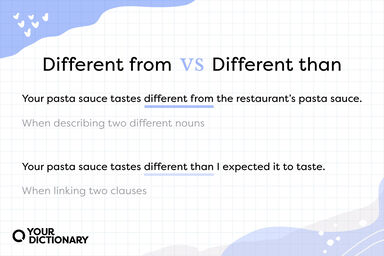
Usage Note: Different from and different than are both common in British and American English. The construction different to is chiefly British. Since the 18th century, language critics have singled out different than as incorrect, though it is well attested in the works of reputable writers. According to traditional guidelines, from is used when the comparison is between two persons or things: My book is different from (not than) yours. Different than is more acceptably used, particularly in American usage, where the object of comparison is expressed by a full clause: The campus is different than it was 20 years ago. Different from may be used with a clause if the clause starts with a conjunction and so functions as a noun: The campus is different from how it was 20 years ago. • Sometimes people interpret a simple noun phrase following different than as elliptical for a clause, which allows for a subtle distinction in meaning between the two constructions. How different this seems from Paris suggests that the object of comparison is the city of Paris itself, whereas How different this seems than Paris suggests that the object of comparison is something like “the way things were in Paris” or “what happened in Paris.”

Learn more about different

different

link/cite print suggestion box