brake

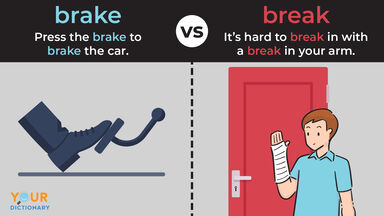
To brake is to slow or stop by pressing on a pedal that cuts off movement.

(verb)

An example of brake is when you step on the pedal in your car that is next to the gas pedal in order to slow down or stop your car.

The definition of a brake is a device used to slow down or stop a vehicle or machine.

(noun)

An example of brake is the device in your car that slows down or stops its movement forward.

YourDictionary definition and usage example. Copyright © 2013 by LoveToKnow Corp.

See brake in Webster's New World College Dictionary

noun

any of a genus (Pteris) of coarse tropical ferns (family Polypodiaceae) used commonly as a houseplant

Origin: ME; prob. taken as sing. of bracken

noun

  1. a toothed implement for beating or crushing flax or hemp so that the fiber can be separated
  2. a heavy harrow for breaking up clods of earth
  3. a handle or lever on a machine: a pump brake
  4. a machine for turning or bending the edges of sheet metal
    1. any device for slowing or stopping the motion of a vehicle or machine, as by causing a block, shoe, or band to press against a moving part
    2. anything that slows down or stops motion or progress
  5. Obsolete the rack, former instrument of torture

Origin: ME < MLowG brake or ODu braeke, flax brake < breken, to break; senses 2-6 variously infl. by OFr brac (form of bras, an arm) & break

transitive verb braked, braking

  1. to break up (flax, clods of earth, etc.) into smaller pieces
  2. to slow down or stop with or as with a brake

intransitive verb

  1. ☆ to operate a brake or brakes
  2. to be slowed down or stopped by a brake

Related Forms:

noun

a clump or area of brushwood, briers, etc.; thicket

Origin: < or akin to MLowG brake, stumps, broken branches, akin to OE brecan, to break

transitive verb, intransitive verb

break

See brake in American Heritage Dictionary 4

noun
  1. A device for slowing or stopping motion, as of a vehicle, especially by contact friction.
  2. Something that slows or stops action.
verb braked braked, brak·ing, brakes
verb, transitive
To reduce the speed of with or as if with a brake.
verb, intransitive
  1. To operate or apply a brake.
  2. To be slowed or stopped by or as if by the operation of a brake.

Origin:

Origin: Probably brake, bridle, curb

Origin: , from Middle Dutch

Origin: or Middle Low German, nose ring, curb, flax brake; see brake2

.

(click for a larger image)

brake1

top: drum brake system

bottom: disc brake system

noun
  1. A toothed device for crushing and beating flax or hemp.
  2. A heavy harrow for breaking clods of earth.
  3. An apparatus for kneading large amounts of dough.
  4. A machine for bending and folding sheet metal.
transitive verb braked braked, brak·ing, brakes
  1. To crush (flax or hemp) in a toothed device.
  2. To break up (clods of earth) with a harrow.

Origin:

Origin: Middle English

Origin: , from Middle Dutch

Origin: , from Middle Low German; see bhreg- in Indo-European roots

.

noun
A lever or handle on a machine such as a pump.

Origin:

Origin: Middle English

Origin: , from Old French brac

Origin: , from

Origin: oblique form of bras, arm; see bracer2

.

noun
  1. Any of various ferns of the genus Pteris having pinnately compound leaves and including several popular houseplants.
  2. Any of certain other ferns, such as the bracken or the cliff brake.

Origin:

Origin: Middle English

Origin: , probably back-formation from braken; see bracken

.

noun
An area overgrown with dense brushwood, briers, and undergrowth; a thicket.

Origin:

Origin: Middle English

Origin: , from Middle Low German; see bhreg- in Indo-European roots

.

noun
Variant of break.
verb
Archaic
A past tense of break.

Learn more about brake

brake

link/cite print suggestion box