speed

Speed is a way of measuring how quickly something is moving or being done, or something moving fast.

(noun)

  1. An example of speed is a car being driven 45 miles per hour.
  2. An example of speed is someone cleaning a room in 10 minutes.
  3. An example of speed is how quickly a jaguar runs.

Speed is a slang term for the street drug methamphetamine.

(noun)

An example of speed is a drug that increases energy, heart rate and makes it very difficult to eat or sleep.

Speed is defined as to help someone or something along, or move too quickly.

(verb)

  1. An example of speed is a restaurant hostess putting regular customers at the top of a table waiting list.
  2. An example of speed is driving 80 mph in a 50 mph zone.

YourDictionary definition and usage example. Copyright © 2013 by LoveToKnow Corp.

See speed in Webster's New World College Dictionary

noun

  1. the act or state of moving rapidly; swiftness; quick motion
    1. the rate of movement or motion; velocity (sense )
    2. the magnitude of a velocity (sense )
    3. the rate or rapidity of any action: reading speed
  2. a gear or arrangement of gears for the drive of an engine or bicycle: a truck with five forward speeds
  3. Informal one's kind or level of taste, capability, etc.
  4. Slang any of various amphetamine compounds, esp. methedrine
  5. Archaic luck; success; prosperity: to wish someone good speed
  6. Photog.
    1. the sensitivity of film to light, expressed in various numerical scales
    2. the widest effective aperture of a camera lens
    3. the length of time the shutter is opened for an exposure

Origin: ME sped < OE spæd, wealth, power, success, akin to spowan, to prosper, succeed < IE base *spēi-, to flourish, expand > space, spare

adjective

of or having to do with speed

intransitive verb sped or speeded, speeding

  1. to move rapidly, esp. more rapidly than is safe or allowed by law
  2. Archaic
    1. to get along; fare
    2. to have fortune, good or bad
    3. to have good fortune; prosper; succeed

transitive verb

  1. to help (a project) to succeed; aid; promote
  2. to wish Godspeed to: to speed the parting guest
  3. to send, convey, or cause to move, go, etc. swiftly: to speed a letter on its way
  4. to cause or design (a machine, etc.) to operate at a certain speed or speeds
  5. Archaic to cause to succeed or prosper

See speed in American Heritage Dictionary 4

noun
  1. Physics The rate or a measure of the rate of motion, especially:
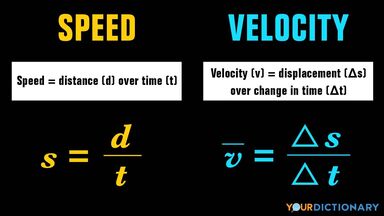
    a. Distance traveled divided by the time of travel.
    b. The limit of this quotient as the time of travel becomes vanishingly small; the first derivative of distance with respect to time.
    c. The magnitude of a velocity.
  2. Swiftness of action.
  3. a. The act of moving rapidly.
    b. The state of being in rapid motion; rapidity.
  4. A transmission gear or set of gears in a motor vehicle.
  5. a. A numerical expression of the sensitivity of a photographic film, plate, or paper to light.
    b. The capacity of a lens to accumulate light at an appropriate aperture.
    c. The length of time required or permitted for a camera shutter to open and admit light.
  6. Slang A stimulant drug, especially amphetamine or methamphetamine.
  7. Slang One that suits or appeals to a person's inclinations, skills, or character: Living in a large city is not my speed.
  8. Archaic Prosperity; luck.
verb sped sped (spĕd) or speed·ed, speed·ing, speeds
verb, transitive
  1. To cause to go, move, or proceed quickly; hasten.
  2. To increase the speed or rate of; accelerate: speed up a car; sped production.
  3. To wish Godspeed to.
  4. To further, promote, or expedite (a legal action, for example).
  5. Archaic To help to succeed or prosper; aid.
verb, intransitive
  1. a. To go, move, or proceed quickly: sped to the rescue.
    b. To drive at a speed exceeding a legal limit: was speeding on the freeway.
  2. To pass quickly: The days sped by. The months have sped along.
  3. To move, work, or happen at a faster rate; accelerate: His pulse speeded up.
  4. Archaic
    a. To prove successful; prosper.
    b. To get along in a specified manner; fare.

Origin:

Origin: Middle English spede

Origin: , from Old English spēd, success, swiftness; see spē- in Indo-European roots

.

Word History: We learn from the fable of the tortoise and the hare that the race is not always to the swift, but etymology teaches us that speed and success are closely related. The Old English word spēd, from which our word speed is descended, originally meant “prosperity, successful outcome, ability, or quickness.” A corresponding verb, spēdan, in Modern English the verb speed, meant “to succeed, prosper, or achieve a goal”; and an adjective, spēdig, the ancestor of our word speedy, meant “wealthy, powerful.” Except for archaic uses the words today relate only to the general sense of “velocity.” The meaning “success” is retained chiefly in the compound Godspeed, a noun formed from the phrase meaning “May God cause you to prosper.”

Learn more about speed

Related Articles

link/cite print suggestion box