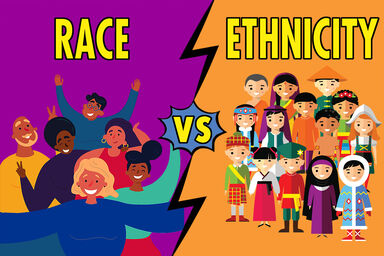
The definition of a race is a contest to see who moves the quickest or a group of people related by common ancestors.
(noun)Race is defined as to compete in a contest of speed.
(verb)An example of race is to participate in a marathon.
See race in Webster's New World College Dictionary
noun
Origin: ME (North) ras(e) < ON rās, a running, rush, akin to OE ræs, swift movement, attack < IE *eras-, to flow, move rapidly < base *er-, *or-, to set in motion > run, orient
intransitive verb raced, racing
transitive verb
noun
Origin: Fr < It razza < ?
See race in American Heritage Dictionary 4
noun
Origin:
Origin: French
Origin: , from Old French
Origin: , from Old Italian razza, race, lineage
. Usage Note: The notion of race is nearly as problematic from a scientific point of view as it is from a social one. European physical anthropologists of the 17th and 18th centuries proposed various systems of racial classifications based on such observable characteristics as skin color, hair type, body proportions, and skull measurements, essentially codifying the perceived differences among broad geographic populations of humans. The traditional terms for these populations—Caucasoid (or Caucasian), Mongoloid, Negroid, and in some systems Australoid—are now controversial in both technical and nontechnical usage, and in some cases they may well be considered offensive. (Caucasian does retain a certain currency in American English, but it is used almost exclusively to mean “white” or “European” rather than “belonging to the Caucasian race,” a group that includes a variety of peoples generally categorized as nonwhite.) The biological aspect of race is described today not in observable physical features but rather in such genetic characteristics as blood groups and metabolic processes, and the groupings indicated by these factors seldom coincide very neatly with those put forward by earlier physical anthropologists. Citing this and other points—such as the fact that a person who is considered black in one society might be nonblack in another—many cultural anthropologists now consider race to be more a social or mental construct than an objective biological fact.noun
Origin:
Origin: Middle English ras
Origin: , from Old Norse rās, rush, running; see ers- in Indo-European roots
.
See race in Ologies
Race
See also anthropology; discrimination; heredity.
albocracy
rule by Caucasians, especially Europeans.
anthroposociology
the sociological study of race using anthropological methods. —anthroposociological, adj.
the policy of strict racial segregation and political and economic discrimination against non-whites practiced in the Republic of South Africa.
Aryanism
1. a doctrine propagandized by Nazism asserting that the so-called Aryan peoples were superior to all others in the practice of government and the development of civilization.
2. a belief in this doctrine and acceptance of its social and ethical implications, especially with regard to the treatment of so-called inferior races. —Aryanist, n.
obtuse or narrow-minded intolerance, especially of other races or religions. —bigot, n., —bigoted, adj.
biracialism
the principle or practice of combining or representing two separate races, as white and Negro, on governing boards, committees, etc. —biracialist, biracial, adj.
cacogenics
Biology. the study of the operation of factors that cause degeneration in offspring, especially as applied to factors unique to separate races. Also called dysgenics. —cacogenic, adj.
creolism
the state of being a creole.
the quality of belonging to a particular race, region, or country. —endemicity, n.
ethnocracy
a government controlled by a particular race or national group. —ethnocratic, adj.
ethnogeography
the study of the geographical distribution of racial groups and the relationship between them and their environments. —ethnogeographer, n. —ethnogeographic, adj.
ethnopsychology
the psychology of races and peoples. —ethnopsychological, adj.
eugenism
the blend of factors and influences most suitable for the improvement of the inherited characteristics of a breed or race, especially the human race. —eugenic, adj.
the art or science of improving a race or breed, especially the human race, by control of external influences, as environment. See also improvement.
1. the deliberate and systematic extermination of a racial or national group.
2. an actor in this process. —genocidal, adj.
gentilism
the state or quality of being non-Jewish, and especially a heathen or pagan.
Gobinism
the theory or doctrine that the white race in general and the Germanic race in particular are superior to all other peoples.
integrationism
the combination of educational and other public facilities, previously segregated by race, into unified systems shared by all races. —integrationist, n. , adj.
interracialism
the principles, beliefs, and attitudes influencing actions aimed at improving relations among differing races. —interracial, adj.
Jensenism
the belief that blacks are mentally inferior to whites, based on results of intelligence tests that failed to account for such differences as test questions slanted in favor of whites, lack of cultural and educational oppor-tunities among blacks, etc. —Jensenist, n., adj.
Melanochroism
the condition of belonging to the Caucasian race and having dark hair and a light complexion. —Melanochroic, adj. —Melanochroid, adj., n.
1. the interbreeding of members of different races.
2. cohabitation or marriage between a man and woman of different races, especially, in the U.S., between a Negro and a white person.
3. the mixing or mixture of races by interbreeding.
monogenism. See also organisms.
the belief that all human races descended from a common ancestral type. Also monogenesis, monogeny. —monogenist, n. —monogenistic, adj.
the condition of being black; blackness.
the theory that all human races descended from two or more ancestral types. —polygenist, n. —polygenistic, adj.
the belief in or practice of the doctrine of racism. —racialist, n. —racialistic, adj.
a belief that human races have distinctive characteristics that determine their respective cultures, usually involving the idea that one’s race is superior and has the right to control others. —racist, adj.
segregationism
the views and policies of those who would separate or maintain as separate rights, public facilities, etc., on the basis of race. See also apartheid.
a person who advocates supremacy of a particular group, especially a racial group.
Xanthochroism
the condition of belonging to the Caucasian race and having fair skin and blond hair. —Xanthochroi, Xanthocroid, n. —Xanthochroic, Xanthocroid, adj.
Learn more about race