Sneak Definition
snēk
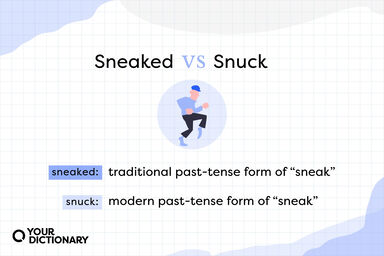
sneaked, sneaking, sneaks, snuck
verb
sneaked, sneaking, sneaks, snuck
To move quietly and stealthily so as to avoid being seen or heard; go furtively.
Webster's New World
To give, put, carry, take, etc. secretly or in a stealthy, sneaking manner.
Webster's New World
To be a sneak; behave in a stealthy, underhanded, or cowardly manner.
Webster's New World
To take something stealthily without permission.
I went to sneak a chocolate but my dad caught me.
Wiktionary
(intransitive) (informal, especially with on) To inform an authority about another's misdemeanours; to tell tales; to grass.
If you sneak on me I'll bash you!
Wiktionary
noun
sneaks
A person who sneaks; stealthy, underhanded, contemptible person.
Webster's New World
An instance of sneaking; a quiet, stealthy movement.
American Heritage
An act of sneaking.
Webster's New World
A sneaker.
American Heritage
Webster's New World
adjective
Carried out in a clandestine manner.
Sneak preparations for war.
American Heritage
Without warning; stealthy.
A sneak attack.
Webster's New World
In advance; before release to the general public.
The company gave us a sneak look at their new electronic devices.
Wiktionary
Synonyms:
idiom
sneak up (on)
- to approach (someone) by or as by stealth
Webster's New World
Other Word Forms of Sneak
Noun
Singular:
sneakPlural:
sneaksIdioms, Phrasal Verbs Related to Sneak
Origin of Sneak
-
From Middle English sniken (“to creep, crawl"), related to Old English snÄ«can (“to desire, reach for sneakily"), from Proto-Germanic *snÄ«kanÄ…, which is related to the root of snake.
From Wiktionary
Probably akin to Middle English sniken to creep from Old English snīcan
From American Heritage Dictionary of the English Language, 5th Edition



Find Similar Words
Find similar words to sneak using the buttons below.