quote

Quote is defined as to reproduce or repeat something written or spoken by someone else.

(verb)

An example of quote is a student reciting Martin Luther King Jr.'s "I Have A Dream" speech at an MLK Day festival.

YourDictionary definition and usage example. Copyright © 2013 by LoveToKnow Corp.

See quote in Webster's New World College Dictionary

transitive verb quoted, quoting

  1. to reproduce or repeat a passage from or statement of: to quote Chaucer
  2. to reproduce or repeat (a passage from a book, a statement, etc.)
  3. to refer to as authority or an example; cite
  4. Commerce to state (a price) or state the price of (something)
  5. Printing to enclose in quotation marks

Origin: altered (infl. by L) < ME coten < ML quotare, to mark the number of, divide into chapters < L quotus, of what number < IE *kwoti-, how many < interrogative base *kwo- > who

intransitive verb

to make a quotation, as from a book or author

noun

  1. quotation
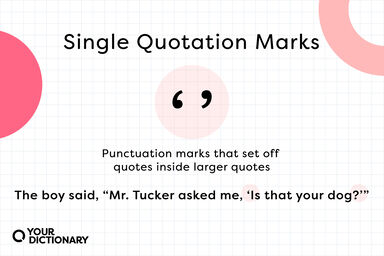
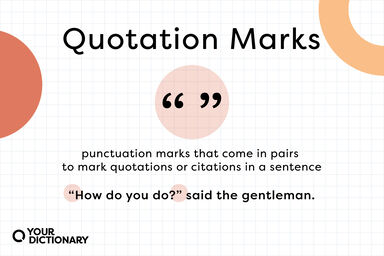
  2. quotation mark

interjection

I shall quote: used in speech to signal the beginning of a quotation

Related Forms:

See quote in American Heritage Dictionary 4

verb quot·ed, quot·ing, quotes
verb, transitive
  1. To repeat or copy the words of (another), usually with acknowledgment of the source.
  2. To cite or refer to for illustration or proof.
  3. To repeat a brief passage or excerpt from: The saxophonist quoted a Duke Ellington melody in his solo.
  4. To state (a price) for securities, goods, or services.
verb, intransitive
To give a quotation, as from a book.
noun
  1. Informal A quotation.
  2. A quotation mark.
  3. Used by a speaker to indicate the beginning of a quotation.
  4. A dictum; a saying.

Origin:

Origin: Middle English coten, to mark a book with numbers or marginal references

Origin: , from Old French coter

Origin: , from Medieval Latin quotāre, to number chapters

Origin: , from Latin quotus, of what number

Origin: , from quot, how many; see kwo- in Indo-European roots

.

Related Forms:

  • quotˈer noun
Usage Note: People have been using the noun quote as a truncation of quotation for over 100 years, and its use in less formal contexts is widespread today. Language critics have objected to this usage, however, as unduly journalistic or breezy. As such, it is best avoided in more formal situations. The Usage Panel, at least, shows more tolerance for the word as the informality of the situation increases. Thus, only 38 percent of Panelists accept the example He began the chapter with a quote from the Bible, but the percentage rises to 53 when the source of the quotation is less serious: He lightened up his talk by throwing in quotes from Marx Brothers movies.

Learn more about quote

Related Articles

link/cite print suggestion box