Phase Definition
fāz
phased, phases, phasing
noun
phases
A distinct stage of development.
American Heritage
A temporary manner, attitude, or pattern of behavior.
Just a passing phase.
American Heritage
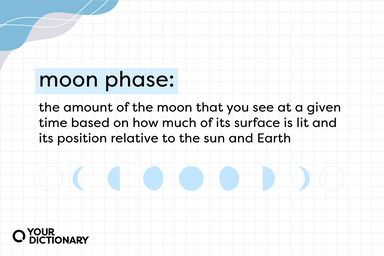
Any of the recurrent stages of variation in the illumination and apparent shape of a moon or a planet.
Webster's New World
An aspect; a part.
We must reconsider every phase of the operation.
American Heritage
Any of the ways in which something may be observed, considered, or presented; aspect; side; part.
A problem with many phases.
Webster's New World
verb
phased, phases, phasing
To move by phases.
Webster's New World
To plan, introduce, or carry out in phases, or stages.
Webster's New World
To put in phase.
Webster's New World
To set or regulate so as to be synchronized.
American Heritage
Webster's New World
pronoun
(obsolete) Passover.
Wiktionary
idiom
in phase
- In a correlated or synchronized way.
American Heritage
out of phase
- In an unsynchronized or uncorrelated way.
American Heritage
in (<i>or</i> out of) phase
- in (or not in) a state of exactly parallel movements, oscillations, etc.; in (or not in) synchronization
Webster's New World
phase out
- to bring or come to an end, or withdraw from use, by stages
Webster's New World
Idioms, Phrasal Verbs Related to Phase
- in phase
- out of phase
- in (or out of) phase
- phase out
Origin of Phase
-
Back-formation from New Latin phasēs phases of the moon from Greek phaseis pl. of phasis appearance from phainein to show bhā-1 in Indo-European roots
From American Heritage Dictionary of the English Language, 5th Edition
-
From New Latin phasis, from Ancient Greek φάσις (phásis, “an appearance”), from φάειν (phaein, “to shine”); compare phantasm and see face.
From Wiktionary
-
From Latin phase (“passover”), Phasa, from Hebrew פָּסַח (pésach).
From Wiktionary
Related Articles

Phase Is Also Mentioned In
Find Similar Words
Find similar words to phase using the buttons below.