noun pl. people - Humans considered as a group or in indefinite numbers: People were dancing in the street. I met all sorts of people.
- A body of persons living in the same country under one national government; a nationality.
- pl. peo·ples A body of persons sharing a common religion, culture, language, or inherited condition of life.
- Persons with regard to their residence, class, profession, or group: city people.
- The mass of ordinary persons; the populace. Used with the: “those who fear and distrust the people, and wish to draw all powers from them into the hands of the higher classes” (Thomas Jefferson).
- The citizens of a political unit, such as a nation or state; the electorate. Used with the.
- Persons subordinate to or loyal to a ruler, superior, or employer: The queen showed great compassion for her people.
- Family, relatives, or ancestors.
- Informal Animals or other beings distinct from humans: Rabbits and squirrels are the furry little people of the woods.
transitive verb peo·pled,
peo·pling,
peo·ples To furnish with or as if with people; populate.
Origin:
Origin: Middle English peple
Origin: , from Old French pueple
Origin: , from Latin populus
Origin: , of Etruscan origin
.
Related Forms:
Usage Note: As a term meaning “a body of persons sharing a culture,”
people is a singular noun, as in
As a people the Pueblo were noteworthy for their peacefulness. Its plural is
peoples: the many and varied peoples of West Africa. But when used to mean “humans,”
people is plural and has no corresponding singular form. English is not unique in this respect; Spanish, Italian, Russian, and many other languages have a plural word meaning “people” that has no singular. Some grammarians have insisted that
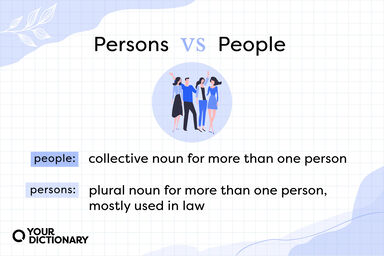
people is a collective noun that should not be used as a substitute for
persons when referring to a specific number of individuals. By this thinking, it is correct to say
Six persons were arrested, not
Six people were arrested. But
people has always been used in such contexts, and almost no one makes the distinction anymore.
Persons is still preferred in legal contexts, however, as in
Vehicles containing fewer than three persons may not use the left lane during rush hours. Only the singular
person is used in compounds involving a specific numeral:
a six-person car; a two-person show. But
people is used in other compounds:
people mover; people power. These examples are exceptions to the general rule that plural nouns cannot be used in such compounds; note that we do not say
teethpaste or
books-burning. See Usage Note at
man.