cloud

The definition of a cloud is a visible mass of small water droplets or ice particles which are suspended in the sky.

Facts About Clouds

  • When a cloud forms in space, it is known as an interstellar cloud, or a nebula.
  • Three components are necessary for clouds to form: water vapor, cool or cold air, and condensation nuclei.
  • A white cloud means that the cloud was formed with warm air. A grey, or a black cloud, means that the cloud contains larger drops of water.
  • There are four main types of clouds:
  • Cumulus - the white and puffy clouds in the sky, generally under 7,000 feet in altitude. Made up almost entirely of water drops.
  • Stratus - the flatter clouds that stretch over greater lengths of distance in the sky, generally under 7,000 feet in altitude. Made up almost entirely of water drops.
  • Cirrus - clouds which are extremely high in the sky, generally over 18,000 feet, and are very thin and feathery looking. Composed primarily of ice crystals.
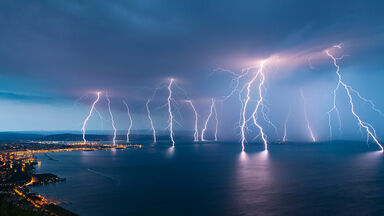
  • Cumulonimbus - clouds which go the highest of all clouds, up to 60,000 feet. They produce storms, thunder and lightening.
(noun)

An example of a cloud is what makes the sky dark on a rainy day.

Cloud is defined as a mass of smoke, dust, steam or a mass of things suspended in the air.

(noun)

  1. An example of a cloud is what forms in the air just after a large explosion.
  2. An example of a cloud is the formation of steam above a factory.
  3. An example of a cloud is a large group of locusts traveling through the air.

To cloud is defined as to darken, cover or make gloomy.

(verb)

An example of to cloud is fog covering a view of the landscape.

YourDictionary definition and usage example. Copyright © 2013 by LoveToKnow Corp.

See cloud in Webster's New World College Dictionary

noun

  1. a visible mass of tiny, condensed water droplets or ice crystals suspended in the atmosphere: clouds are commonly classified in four groups: A (high clouds above 6,096 m or 20,000 ft) cirrus, cirrostratus, cirrocumulus; B (intermediate clouds, 1,981 m to 6,096 m or 6,500 to 20,000 ft) altostratus, altocumulus; C (low clouds, below 1,981 m or 6,500 ft) stratus, stratocumulus, nimbostratus; D (clouds of great vertical continuity) cumulus, cumulonimbus
  2. a mass of smoke, dust, steam, etc.
  3. a great number of things close together and in motion: a cloud of locusts
  4. an appearance of murkiness or dimness, as in a liquid
  5. a dark marking, as in marble
  6. anything that darkens, obscures, threatens, or makes gloomy

Origin: ME cloude, clude, orig., mass of rock, hence, mass of cloud < OE clud, mass of rock: for IE base see climb

transitive verb

  1. to cover or make dark as with clouds
  2. to make muddy or foggy
  3. to darken; obscure; threaten
  4. to make gloomy or troubled
  5. to cast slurs on; sully (a reputation, etc.)

intransitive verb

  1. to become cloudy
  2. to become gloomy or troubled

See cloud in American Heritage Dictionary 4

noun
  1. a. A visible body of very fine water droplets or ice particles suspended in the atmosphere at altitudes ranging up to several miles above sea level.
    b. A mass, as of dust, smoke, or steam, suspended in the atmosphere or in outer space.
  2. A large moving body of things in the air or on the ground; a swarm: a cloud of locusts.
  3. Something that darkens or fills with gloom.
  4. A dark region or blemish, as on a polished stone.
  5. Something that obscures.
  6. Suspicion or a charge affecting a reputation.
  7. A collection of charged particles: an electron cloud.
verb cloud·ed, cloud·ing, clouds
verb, transitive
  1. To cover with or as if with clouds: Mist clouded the hills.
  2. To make gloomy or troubled.
  3. To obscure: cloud the issues.
  4. To cast aspersions on; sully: Scandal clouded the officer's reputation.
verb, intransitive
To become cloudy or overcast: The sky clouded over.

Origin:

Origin: Middle English, hill, cloud

Origin: , from Old English clūd, rock, hill

.

Related Forms:

  • cloudˈless adjective

Learn more about cloud

cloud

link/cite print suggestion box