brain

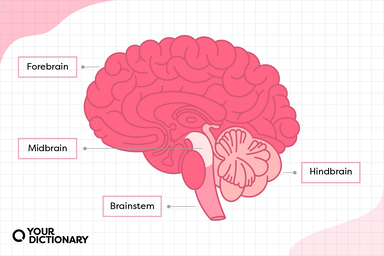
The definition of a brain is the mass of nerve tissue located in the head of animals with spinal cords; it is the center of thought and controls movement.

(noun)

An example of brain is what is damaged when someone has Alzheimer's disease.

A brain is defined as a smart or intellectual person.

(noun)

An example of brain is a student who is valedictorian of their class.

YourDictionary definition and usage example. Copyright © 2013 by LoveToKnow Corp.

See brain in Webster's New World College Dictionary

noun

  1. the mass of nerve tissue in the cranium of vertebrate animals, an enlarged extension of the spinal cord: it is the main part of the nervous system, the center of thought, and the organ that perceives sensory impulses and regulates motor impulses: it is made up of gray matter (the outer cortex of nerve cells) and white matter (the inner mass of nerve fibers)
  2. a comparable organ in invertebrate animals
    1. intelligence; mental ability
    2. Informal a person of great intelligence
  3. Informal the main organizer or planner of a group activity; chief controller or director

Origin: ME < OE brægen < IE base *mregh-m(n)o-, skull, brain > Gr bregma, forehead

transitive verb

  1. to dash out the brains of
  2. Slang to hit hard on the head

See brain in American Heritage Dictionary 4

noun
  1. a. The portion of the vertebrate central nervous system that is enclosed within the cranium, continuous with the spinal cord, and composed of gray matter and white matter. It is the primary center for the regulation and control of bodily activities, receiving and interpreting sensory impulses, and transmitting information to the muscles and body organs. It is also the seat of consciousness, thought, memory, and emotion.
    b. A functionally similar portion of the invertebrate nervous system.
  2. a. Intellectual ability; mind: a dull brain; a quick brain.
    b. Intellectual power; intelligence. Often used in the plural: has brains and good looks. See Synonyms at mind.
  3. A highly intelligent person.
  4. The primary director or planner, as of an organization or movement. Often used in the plural.
  5. The control center, as of a ship, aircraft, or spacecraft.
transitive verb brained, brain·ing, brains brains
Slang
  1. To smash in the skull of.
  2. To hit on the head.

Origin:

Origin: Middle English

Origin: , from Old English brǽgen

.

(click for a larger image)

brain

A. pituitary gland B. cerebrum C. skull D. corpus callosum E. thalamus F. hypothalamus G. pons H. cerebellum I. medulla J. spinal cord

See brain in Ologies

Brain

See also anatomy; body, human; head.

biofeedback

the process of providing a person with visual or auditory evidence of the quality of an autonomie physiological function so that he may attempt to exercise conscious control over it.

cerebrology

1. Obsolete, the branch of psychology that studies the brain.

2. Medicine. the total knowledge concerning the brain.

craniotomy

the surgical operation of opening the skull, as for an operation on the brain.

cybernetics

the comparative study of complex electronic devices and the nervous system in an attempt to understand better the nature of the human brain. —cyberneticist, n.cybernetic, adj.

encephalitis

an inflamed condition of the brain.

heterotopy, heterotopia

a condition in which normal tissue is misplaced, especially in the brain, so that masses of gray matter are found in the white matter. See also biology.. —heterotopous, adj.

lobotomy

surgical severing of certain nerve fibers in the frontal lobe of the brain, once commonly performed to treat intractable depression. Also called prefrontal lobotomy.

menticide

the process of systematically altering beliefs and attitudes, especially through the use of drugs, torture, or psychological stress techniques; brainwashing.

phrenomagnetism

brain stimulation by hypnosis or magnetism.

prosencephalon

the forebrain. —prosencephalies, adj.

psychokinesis

a form of extreme or violent cerebral activity caused by defective inhibition. —psychokinetic, adj.

psychosurgery

the use of brain surgery to treat mental disorders. —psychosurgeon, n.

sensorium

the sensory apparatus of the body as a whole; the seat of physical sensation, imagined to be in the gray matter of the brain.

synectics

a procedure for the stating and solving of problems based upon creative thinking in figurative terms by a small, carefully chosen, and diversely specialized group.

telencephalon

the anterior section of the forebrain, containing the cerebrum and related structures. —telencephalic, adj.

telergy

the influence one brain is thought to exercise over another, from a distance, by means of some hypothetical mental energy.

topectomy

surgical excision of part of the cerebral cortex, as to provide relief for pain or treat certain mental disorders.

Learn more about brain

brain

link/cite print suggestion box