Predicate Definition
prĕdĭ-kāt
predicated, predicates, predicating
verb
predicated, predicates, predicating
To base or establish (a statement or action, for example).
I predicated my argument on the facts.
American Heritage
To affirm as a quality, attribute, or property of a person or thing.
To predicate the honesty of another's motives.
Webster's New World
To proclaim; preach; declare; affirm.
Webster's New World
To make an affirmation or statement.
Webster's New World
To assert (something) about the subject of a proposition.
Webster's New World
noun
predicates
The verb or verbal phrase, including any complements, objects, and modifiers, that is one of the two immediate constituents of a sentence and asserts something about the subject.
Webster's New World
Something that is affirmed or denied about the subject of a proposition (Ex.: green in “grass is green”)
Webster's New World
(grammar) The part of the sentence (clause) which states something about the subject or the object of the sentence.
In "The dog barked very loudly", the subject is "the dog" and the predicate is "barked very loudly".
Wiktionary
A nullary predicate is a proposition. Also, an instance of a predicate whose terms are all constant "” e.g., P(2,3) "” acts as a proposition.
A predicate can be thought of as either a relation (between elements of the domain of discourse) or as a truth-valued function (of said elements).
A predicate is either valid, satisfiable, or unsatisfiable.
There are two ways of binding a predicate's variables: one is to assign constant values to those variables, the other is to quantify over those variables (using universal or existential quantifiers). If all of a predicate's variables are bound, the resulting formula is a proposition.
Wiktionary
Synonyms:
- verb-phrase
- word
- part-of-speech
- verbal phrase
- verb
adjective
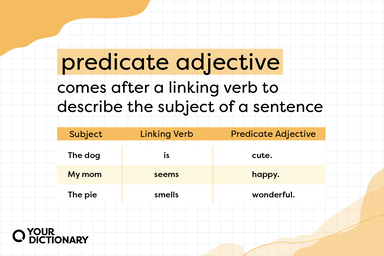
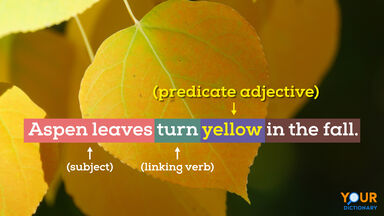
Being or forming part of the predicate of a sentence.
A predicate adjective.
Webster's New World
Stated or asserted; predicated.
American Heritage
Origin of Predicate
From Middle French predicate (French prédicat), from post-classical Late Latin praedicatum (“thing said of a subject"), a noun use of the neuter past participle of praedicare (“proclaim"), as Etymology 2, below.
From Wiktionary
-
Late Latin praedicāre praedicāt- from Latin to proclaim prae- pre- dicāre to proclaim deik- in Indo-European roots
From American Heritage Dictionary of the English Language, 5th Edition
-
From Latin predicātus, perfect passive participle of praedicō, from prae + dicō (“declare, proclaim"), from dicō (“say, tell").
From Wiktionary




Find Similar Words
Find similar words to predicate using the buttons below.