Irony Definition
īrə-nē, īər-
ironies
noun
ironies
The use of words to express something different from and often opposite to their literal meaning.
American Heritage
A method of humorous or subtly sarcastic expression in which the intended meaning of the words is the direct opposite of their usual sense.
The irony of calling a stupid plan “clever”
Webster's New World
An instance of this.
Webster's New World
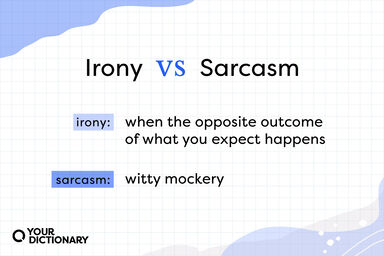
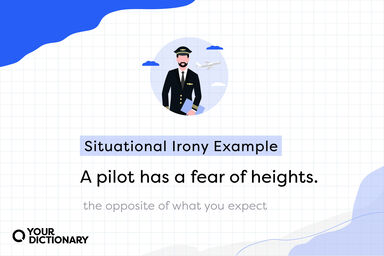
Incongruity between what might be expected and what actually occurs.
American Heritage
The contrast, as in a play, between what a character thinks the truth is, as revealed in a speech or action, and what an audience or reader knows the truth to be.
Webster's New World
Synonyms:
Antonyms:
adjective
Of, like, or containing iron.
Webster's New World
Other Word Forms of Irony
Noun
Singular:
ironyPlural:
ironiesOrigin of Irony
-
French ironie from Old French from Latin īrōnīa from Greek eirōneia feigned ignorance from eirōn dissembler probably from eirein to say wer-5 in Indo-European roots
From American Heritage Dictionary of the English Language, 5th Edition
-
First attested in 1502. From Middle French ironie, from Old French, from Latin īrōnīa, from Ancient Greek εἰρωνεία (eirōneia, “irony, pretext”), from εἴρων (eirōn, “one who feigns ignorance”).
From Wiktionary
-
iron + -y
From Wiktionary




Find Similar Words
Find similar words to irony using the buttons below.