church

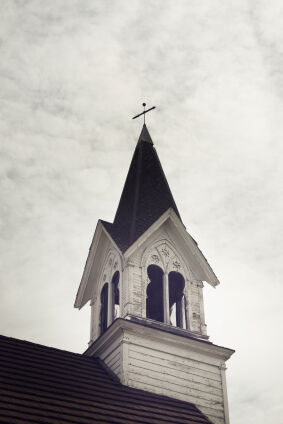
The definition of church is a religious institution of worship, or is the building where religious worship takes place.

(noun)

  1. An example of church is the Christian church.
  2. An example of church is where a religious service regularly takes place.

YourDictionary definition and usage example. Copyright © 2013 by LoveToKnow Corp.

See church in Webster's New World College Dictionary

noun

  1. a building set apart or consecrated for public worship, esp. one for Christian worship
  2. religious service or public worship, esp. among Christians
    1. all Christians considered as a single body
    2. a particular sect or denomination of Christians
  3. the ecclesiastical government of a particular religious group, or its power, as opposed to secular government
  4. the profession of the clergy; clerical profession
  5. a group of worshipers; congregation

Origin: ME chirche, kirke < OE cirice (& ON kirkja < OE) < Gmc *kirika < LGr(Ec) *kyrikē < Gr kyriakē (oikia), Lord's (house) < kyriakos, belonging to the Lord < kyrios, ruler < kyros, supreme power < IE base *eu-, a swelling, to be strong, hero > cave

transitive verb

to bring (esp. a woman after childbirth) to church for special services

adjective

  1. having to do with organized Christian worship
  2. of or connected with a church

Church, Frederic Edwin 1826-1900; U.S. landscape painter

See church in American Heritage Dictionary 4

noun
  1. A building for public, especially Christian worship.
  2. often Church
    a. The company of all Christians regarded as a spiritual body.
    b. A specified Christian denomination: the Presbyterian Church.
    c. A congregation.
  3. Public divine worship in a church; a religious service: goes to church at Christmas and Easter.
  4. The clerical profession; clergy.
  5. Ecclesiastical power as distinguished from the secular: the separation of church and state.
transitive verb churched, church·ing, church·es
To conduct a church service for, especially to perform a religious service for (a woman after childbirth).
adjective
Of or relating to the church; ecclesiastical.

Origin:

Origin: Middle English chirche

Origin: , from Old English cirice

Origin: , ultimately from Medieval Greek kūrikon

Origin: , from Late Greek kūriakon (dōma), the Lord's (house)

Origin: , neuter of Greek kūriakos, of the lord

Origin: , from kūrios, lord; see keuə- in Indo-European roots

.

American painter and leader of the Hudson River School. His works include Heart of the Andes (1859).

See church in Ologies

Church

See also christianity; religion

collegialism

the belief that the church as an organization is independent of and equal to the state, with its highest authority lying in its collective membership.

diaconate

the rank or office of a deacon.

ecclesiarch

Eastern Church. sacristan.

ecclesiasticism

an excessive adherence to the doctrines and practices of the church. —ecclesiastic, n., adj. —ecclesiastical, adj.

ecclesioclasticism

Rare. an opposition to the church.

ecclesiography

a descriptive study of the church. —ecclesiographer, n. —ecclesiographic, ecclesiographical, adj.

ecclesiolatry

an intense devotion to church forms, authority, and traditions.

ecclesiology

1. the study of church building and decoration.

2. Theology. the doctrine of the church.

3. the policy and operations of the church. —ecclesiologist, n. —ecclesiologic, ecclesiological, adj.

ecclesiophobia

an abnormal fear or dislike of the church.

festilogy

a dissertation on church festivals.

hieromania

a mania for priests.

lectionary

a list of the lections, or texts, to be read in church services through-out the canonical year.

nonage

formerly, a ninth part of a parishioner’s movable property, which was claimed upon his death by the clergy in England. See also law.

precentor

a person who leads a church choir or congregation in singing.

sacristan

an official or cleric appointed curator of the vestments, sacred vessels, and relies of a religious body, church, or cathedral.

simony

the sin or offense of selling or granting for personal advantage church appointments, benefices, preferments, etc. —simoniac, simonist, n.

spoliation

Church Law. the taking of property by an incumbent upon resignation or any other departure. See also ships; theft; war.

Learn more about church

Related Articles

church

link/cite print suggestion box