Phenomenon Definition
fĭ-nŏmə-nŏn, -nən
phenomena, phenomenons
noun
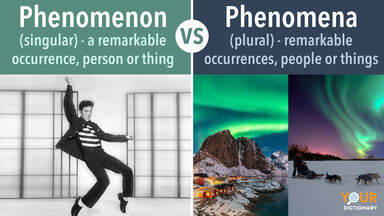
Any event, circumstance, or experience that is apparent to the senses and that can be scientifically described or appraised, as an eclipse.
Webster's New World
In Kantian philosophy, a thing as it appears in perception as distinguished from the thing as it is in itself independent of sense experience.
Webster's New World
Any extremely unusual or extraordinary thing or occurrence.
Webster's New World
A person with an extraordinary quality, aptitude, etc.; prodigy.
Webster's New World
In the philosophy of Kant, an object as it is perceived by the senses, as opposed to a noumenon.
American Heritage
Synonyms:
Antonyms:
Origin of Phenomenon
-
From Late Latin phaenomenon (“appearance"), from Ancient Greek φαινόμενον (phainomenon, “thing appearing to view"), neuter present passive participle of φαίνω (phainō, “I show").
From Wiktionary
-
Late Latin phaenomenon from Greek phainomenon from neuter present participle of phainesthai to appear bhā-1 in Indo-European roots
From American Heritage Dictionary of the English Language, 5th Edition
Related Articles


Find Similar Words
Find similar words to phenomenon using the buttons below.