passive

The definition of passive is not reacting to something that would generally cause a response.

(adjective)

An example of passive is sitting quietly while someone calls you cruel names.

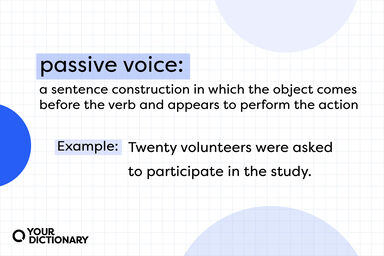
Passive is defined as a sentence that is formed by a noun, then a verb then the phrase "by (noun)."

(noun)

An example of passive is the sentence "The book was moved by the boy."

YourDictionary definition and usage example. Copyright © 2013 by LoveToKnow Corp.

See passive in Webster's New World College Dictionary

adjective

  1. influenced or acted upon without exerting influence or acting in return; inactive, but acted upon
  2. offering no opposition or resistance; submissive; yielding; patient
  3. taking no active part; inactive
    1. Chem. inert (sense )
    2. resistant to corrosion
  4. Finance of or relating to an investment that does not involve active participation in management, policy making, etc.: passive losses
  5. Gram.
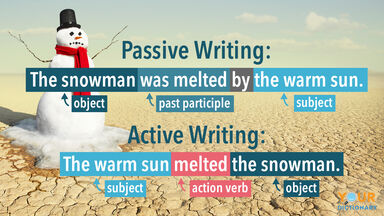
    1. denoting the voice or form of a verb whose subject is the recipient (object) of the action of the verb: opposed to active
    2. in or of the passive voice: in “The tree was struck by lightning,” was struck is a passive construction

Origin: ME passif < L passivus < passus: see passion

noun

  1. the passive voice
  2. a verb in this voice

Related Forms:

See passive in American Heritage Dictionary 4

adjective
  1. Receiving or subjected to an action without responding or initiating an action in return: the mind viewed as a passive receptacle for sensory experience. See Synonyms at inactive.
  2. Accepting or submitting without objection or resistance; submissive: a passive acceptance of one's fate.
  3. Existing, conducted, or experienced without active or concerted effort: “Although tick paralysis is a reportable disease in Washington, surveillance is passive, and only 10 cases were reported during 1987-1995” (U.S. Department of Health and Human Services). [Many parents believe] that computers are educational and, at the least, less passive than television” (Tamar Lewin).
  4. Of, relating to, or being certain bonds or shares that do not bear financial interest.
  5. Of, relating to, or being a solar heating or cooling system that uses no external mechanical power.
  6. Grammar Of, relating to, or being a verb form or voice used to indicate that the grammatical subject is the object of the action or the effect of the verb. For example, in the sentence They were impressed by his manner, were impressed is in the passive voice.
  7. Chemistry Unreactive except under special or extreme conditions; inert.
  8. Electronics Exhibiting no gain or contributing no energy: a passive circuit element.
  9. Psychology Relating to or characteristic of an inactive or submissive role in a relationship, especially a sexual relationship.
noun
  1. Grammar
    a. The passive voice.
    b. A verb or construction in the passive voice.
  2. One that is submissive or inactive. Often used in the plural: “And the rest of us, we passives of the world, proceeded . . . as if nothing untoward had happened” (Martin Gottfried).

Origin:

Origin: Middle English

Origin: , from Old French passif

Origin: , from Latin passīvus, subject to emotion, the passive

Origin: , from passus

Origin: , past participle of patī, to suffer; see pē(i)- in Indo-European roots

.

Related Forms:

  • pasˈsive·ly adverb
  • pasˈsive·ness noun

Learn more about passive

link/cite print suggestion box