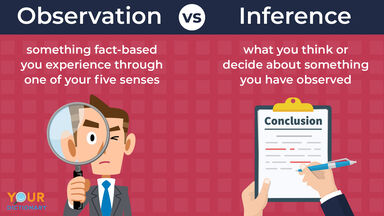
inference Hear it!

inference Definition

in·fer·ence (infər əns)

noun

  1. an act or the process of inferring
  2. a conclusion or opinion arrived at by inferring

Etymology: ML inferentia

inference Synonyms

inference

n.

  1. A judgment

    deduction, conclusion, summation, answer; see judgment 3, result.

  2. A concluding

    reasoning, inferring, deducing; see thought 1.

  3. A supposition

    presumption, conjecture, surmise; see assumption 1, opinion 1, thought 2.

inference Law Definition

n

A logical conclusion drawn from available facts; the process of arriving at such a conclusion.

inference Usage Examples

Preposition: of

discrimination: Employers need to bear in mind that tribunals may draw inferences of discrimination from the arrangements adopted by the employers.

Converse of object

  • draw: No skill in drawing inferences will avail him there.
  • justify: Possession of nuclear weapons may indeed justify an inference of preparedness to use them.
  • derive: By manipulating the pointers, subjects can derive inferences that are not explicit in the text.
  • license: That claim would seem at most to license the very different inference that we cannot tell whether they tell the truth or lie.
  • perform: We use Bayesian networks ( BN ) to perform probabilistic inference.
  • permit: However, the Inquiry is concerned that current categorisations used in the SSCSS survey do not permit clear inferences to be drawn.

Adjective modifier

  • inductive: Such a method is that founded on inductive inference.
  • bayesian: Earlier studies have used Bayesian inference under simplifying assumptions.
  • nonparametric: Conference on Nonparametric Inference and Probability with Applications to Science, Ann Arbor, Michigan ( September 2005 ).
  • deductive: Hence, the attempt to rescue inductive inferences by grafting deductive inferences onto them disguises rather than solves the problem of induction.
  • statistical: The model's regime probabilities provide an optimal statistical inference of the turning point of the European business cycle.
  • phylogenetic: A new Monte Carlo Markov chain method has the capacity to perform Bayesian phylogenetic inference in a relaxed clock framework.

Modifies a noun

  • making: These notions describe properties of the processes that underlie inference making.
  • engine: The inference engine will assign the outcome ' credit limit is low ' , the maximum MV from all the fired rules.
  • algorithm: We shall focus on Hidden Markov models and Phylogenetic inference algorithms for Comparative Genomics.
  • rule: Certain macros are used by the default inference rules to permit the inclusion of optional matter in any resulting commands.
  • mechanism: The data is dependent on the kind of inference mechanism used.
  • step: In this way, a chain of inference steps will lead to a value for the goal being found.

Noun used with modifier

type: This should help finding the origin of type errors without detailed knowledge of type inference on the user side.