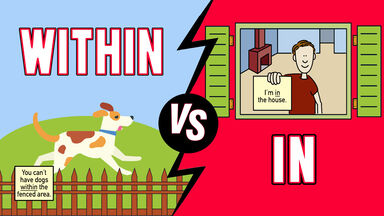
in

In is defined as inside the area, moving from a point outside to point inside or having a specific occupation or function.

(preposition)

  1. An example of in is a letter being enclosed by an envelope.
  2. An example of in is a basketball player dunking a ball through a hoop.
  3. An example of in is someone who works as an educator.

In is defined as not, or into.

(prefix)

  1. An example of in used as a prefix is in the word "inadequate," which means not enough.
  2. An example of in used as a prefix is in the word "inbreed," which to breed by mating people or animals which are closely related.

In is defined as going from outside to inside.

(adverb)

An example of in is to walk into a house from the backyard.

The definition of in is successful or powerful.

(adjective)

An example of in is are people who are the most looked-up to or the most fashionable.

YourDictionary definition and usage example. Copyright © 2013 by LoveToKnow Corp.

See in in Webster's New World College Dictionary

  1. contained or enclosed by; inside; within: in the room, in the envelope
  2. wearing; clothed by: to dress in one's best
  3. during the course of: done in a day
  4. at or before the end of: return in an hour
  5. perceptible to (one of the senses): the town is in sight; he told a lie in my hearing
  6. limited by the scope of: in my opinion
    1. being a member of or worker at: in the navy, in business
    2. being a student at: she's in college
    3. being an inmate of: to be in prison
  7. out of a group or set of: one in ten will fail
  8. amidst; surrounded by: in a storm, in total darkness
  9. affected by (a specified state or condition); having: he's in trouble; they were in tears
  10. engaged or occupied by (an activity or process): in a search for truth, deep in thought
  11. with regard to; as concerns: weak in faith, to vary in size, six feet two in height
  12. so as to form; arranged to produce the form or shape of: hair done in curls, standing in a line
  13. with; by; using: to paint in oils, written in English, sculpture done in wood
  14. because of; for: to cry in pain
  15. by way of; for the purpose of: do this in my defense
  16. as a part of the capacity or function of; belonging to: he didn't have it in him to cheat; can you find it in yourself to forgive her?
  17. into [break it in two; come in the house]: when the idea of motion from outside to inside is intended, into is generally preferred
  18. living or located at: vacationing in Venice

Origin: ME < OE, akin to Ger in < IE base *en- > Gr en, L in (OL en), OIr in, OSlav on-, Sans an-

adverb

  1. from a point outside to one inside: to invite visitors in
  2. to or toward a certain place or direction: he flies in today, they live ten miles in
  3. at or inside one's home, office, etc.: forced to stay in for a day
    1. so as to be contained by a certain space or condition
    2. so as to be in office or power
  4. so as to be agreeing or involved: he fell in with our plans
  5. so as to form a part: mix in the cream

adjective

  1. that is successful or in power: the in group
  2. inner; inside
  3. coming or going inside or inward: the in door, the in boat
  4. completed, gathered, counted, etc.: the votes are in
  5. Informal profiting to the extent of: to be in $100
  6. Informal currently smart, popular, fashionable, etc.: an in place to go
  7. Informal known to or able to be understood by only a certain group of people; inside (): an in joke

noun

  1. a person, group, etc. that is in power, in office, or in a favored position: usually used in pl.
  2. Informal special influence or favor; pull

transitive verb inned, inning

  1. to collect; gather in: in the hay before it rains
  2. to enclose

inch(es)

Indiana

indium

Indiana

in, into, within, on, toward: also used as an intensifier in some words of Latin origin [inbreed, infer, induct, instigate]: it becomes il- before l; im- before b, m, or p; and ir- before r

Origin: < the prep. in; also ME < OE inn & MFr in- or OFr en- < L in- < in: see in

no, not, without, non- [insignificant]: it becomes il- before l;im- before b, m, or p; and ir- before r

Origin: ME < OFr & ML < L < IE *ṇ-, initial negative particle, var. of *ne, *nē- > no, L ne-

  1. a neutral carbohydrate: inulin
  2. a glycoside: amygdalin
  3. a protein: albumin
  4. a glyceride: palmitin
  5. an enzyme: rennin
  6. an antibiotic: streptomycin
  7. an alkaloid or a nitrogenous base: codein
  8. a pharmaceutical preparation: chrysarobin
  9. a commercial product, material, or mixture: algin
  10. an antigen: tuberculin

Origin: see -ine

any of various mass actions or gatherings of a (specified) type, as a political demonstration or a form of entertainment: pray-in, be-in

See in in American Heritage Dictionary 4

preposition
  1. a. Within the limits, bounds, or area of: was hit in the face; born in the spring; a chair in the garden.
    b. From the outside to a point within; into: threw the letter in the wastebasket.
  2. To or at a situation or condition of: was split in two; in debt; a woman in love.
  3. a. Having the activity, occupation, or function of: a life in politics; the officer in command.
    b. During the act or process of: tripped in racing for the bus.
  4. a. With the arrangement or order of: fabric that fell in luxuriant folds; arranged to purchase the car in equal payments.
    b. After the style or form of: a poem in iambic pentameter.
  5. With the characteristic, attribute, or property of: a tall man in an overcoat.
  6. a. By means of: paid in cash.
    b. Made with or through the medium of: a statue in bronze; a note written in German.
  7. With the aim or purpose of: followed in pursuit.
  8. With reference to: six inches in depth; has faith in your judgment.
  9. Used to indicate the second and larger term of a ratio or proportion: saved only one in ten.
adverb
  1. To or toward the inside: opened the door and stepped in.
  2. To or toward a destination or goal: The mob closed in.
  3. Sports So as to score, as by crossing home plate in baseball: singled the runner in.
  4. Within a place, as of business or residence: The manager is in before anyone else.
  5. So as to be available or under one's control: We can proceed when all the evidence is in.
  6. So as to include or incorporate: Fold in the egg whites.
  7. So as to occupy a position of success or favor: campaigned hard and was voted in.
  8. In a particular relationship: got in bad with their supervisor.
adjective
  1. Located inside; inner.
  2. Incoming; inward: took the in bus.
  3. Holding office; having power: the in party.
  4. Informal
    a. Currently fashionable: the in thing to wear this season.
    b. Concerned with or attuned to the latest fashions: the in crowd. See Synonyms at fashionable.
  5. Relating to, understandable to, or coming from an exclusive group: an in reference.
noun
  1. One that has position, influence, or power: the ins against the outs.
  2. Informal Influence; power: had an in with the authorities.

Origin:

Origin: Middle English

Origin: , from Old English; see en in Indo-European roots

.

or in.

abbreviation
inch

The symbol for the element indium.

abbreviation
Indiana

abbreviation
India (in Internet addresses)

or il- or im- or ir-

prefix
Not: inarticulate. Before l, in- is usually assimilated to il-; before r to ir-; and before b, m, and p to im-. See Usage Note at un-1.

Origin:

Origin: Middle English

Origin: , from Old French

Origin: , from Latin; see ne in Indo-European roots

.

or il- or im- or ir-

prefix
  1. In; into; within: inundation. Before l, in- is usually assimilated to il-; before r to ir-; and before b, m, and p to im-.
  2. Variant of en-1.

Origin:

Origin: Middle English

Origin: , from Old English (from in, in; see in1)

Origin: and from Old French (from Latin, from in, in, within; see en in Indo-European roots)

.

suffix
  1. Neutral chemical compound, especially:
    a. Neutral carbohydrate: inulin.
    b. Protein or protein derivative: albumin.
    c. Lipid or lipid derivative: lecithin.
    d. Enzyme: pancreatin.
    e. Glycoside: chitin.
  2. A pharmaceutical: rifampin.
  3. An antibiotic: penicillin.
  4. Antigen: tuberculin.
  5. Variant of -ine2.

Origin:

Origin: Variant of -ine2

.

Learn more about in

Related Articles

in

link/cite print suggestion box