hypothesis Hear it!

hypothesis Definition

hy·poth·esis (hī pät̸hə sis, hi-)

noun pl. -·ses′--sēz′

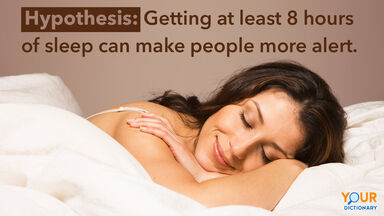
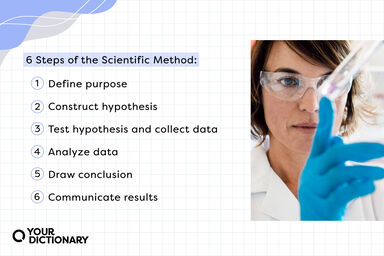
an unproved theory, proposition, supposition, etc. tentatively accepted to explain certain facts or (working hypothesis) to provide a basis for further investigation, argument, etc.

Etymology: Gr, groundwork, foundation, supposition < hypotithenai, to place under < hypo-, under + tithenai, to place: see hypo- & do

hypothesis Synonyms

hypothesis

n.

theory, supposition, surmise, speculation, scheme, system, conjecture, prediction, assumption, presumption, condition, suggestion, thesis, proposal, working hypothesis, preliminary layout, tentative plans, basis for discussion, apriority, law, inference, antecedent, reason, position, assignment, starting point, basis, derivation, philosopheme, ground, term, scheme, belief, foundation, postulate, axiom, presupposition, premise, data, attribution, interpretation, deduction, demonstration, tentative law, principle, lemma, explanation, theorem, rationale, philosophy, shot in the dark*, guess-so*, clotheshorse*; see also guess, opinion 1, theory 1. See syn. study at theory.

hypothesis Usage Examples

Preposition: of

  • crowd-out: All participants complete percent of the hypothesis of crowd-out we would expect.

Converse of object

  • formulate: In the worst case scenario, the model maker is forced just to formulate hypotheses about them.
  • reject: In this case, the correct decision is to reject the null hypothesis.
  • disprove: However it is not the subject matter of this book to attempt to prove or disprove any survival hypothesis.
  • refute: Unfortunately there is no data to accept or refute these hypotheses.
  • test: A group in Paignton Zoo decided to test the hypothesis.
  • explode: In Part Four, Alan Alford uses the exploded planet hypothesis to provide a complete decoding of Plato's Atlantis story.

Adjective modifier

  • null: For these experiments, the null hypothesis was rejected.
  • testable: However, it would be surprising if a new ontology yielded testable hypotheses.
  • chemiosmotic: So he was reluctant to accept the chemiosmotic hypothesis in the first place.
  • extraterrestrial: Trying to fit this case into the extraterrestrial hypothesis presents a series of problems.
  • plausible: A rational model is suggested, where the most plausible hypothesis is selected first.
  • chilling: Be ready to quot chilling quot hypothesis for the robert.

Modifies a noun

  • testing: Take, for instance, the basic concept of hypothesis testing.

Noun used with modifier

  • priori: The trick of course is to find an alternative a priori hypothesis.
  • verb-island: Comparing the verb-island hypothesis account of syntax acquisition with a distributional account.
  • prion: In 1986 the prion hypothesis was still regarded as highly controversial.
  • quot: Quot hypothesis on study sample is bit yielded a we used nuclear.
  • continuum: Nowadays " = c " is called the " continuum hypothesis " and can be taken as an axiom of set theory.
  • unproven: Even unproven hypotheses of the existence of things can be useful.
hypothesis Quotes

What is the character of a family to an hypothesis? my father would reply.

—Sterne, Laurence

   I cannot give any scientist of anyage better advice than this: the intensityof a conviction that a hypothesisistrue has no bearing over whether it is true or not.

—Medawar, Sir Peter Brian

Uberhaupt ist es fu«  r den Forscher ein guter Morgensport, t a« glich vor dem Fru«  hstu«  ck eine Lieblingshypothese einzustampfenödas erh a« lt jung. It is a good morning exercise for a research scientist to discard a pet hypothesis every day before breakfast. It keeps him young.

—Lorenz, Konrad

Humanbeings, intheirgenerous endeavour to construct a hypothesis that shall not degrade a First Cause, have always hesitated to conceive a dominant power of a lower moral quality than their own.

—Hardy,Thomas

It is the nature of an hypothesis, when once a man has conceived it, that it assimilates everything to itself, as proper nourishment; and, from the first moment of your begetting it, it generally grows the stronger by every thing you see, hear, read, or understand.

—Sterne, Laurence

   The great tragedy of Scienceöthe slaying of a beautiful hypothesis byan ugly fact.

—Huxley,T(homas) H(enry)