hang

To hang is defined as to attach to something above without any support underneath.

(verb)

  1. An example of to hang is attaching a painting to a wall.
  2. An example of to hang is a suspended trapeze performer.

YourDictionary definition and usage example. Copyright © 2013 by LoveToKnow Corp.

See hang in Webster's New World College Dictionary

transitive verb hung, hanging, hanged

  1. to attach to something above with no support from below; suspend
  2. to attach so as to permit free motion at the point of attachment: to hang a door on its hinges
  3. to put to death by tying a rope about the neck and suddenly suspending the body so as to snap the neck or cause strangulation
  4. to fasten (pictures, etc.) to a wall by hooks, wires, etc.
  5. to ornament or cover with things suspended: to hang a room with pictures and drapes
  6. to paste (wallpaper) to walls
  7. to exhibit (pictures) in a museum or gallery
  8. to let (one's head) droop downward
  9. to fasten (an ax head, scythe blade, etc.) with correct balance
  10. to pin and sew the hem of (a dress) evenly at a desired distance from the floor
  11. ☆ to deadlock (a jury) by one's vote
  12. to fix (something) on a person or thing
  13. Baseball to pitch (a breaking ball) that fails to curve sharply and is therefore easy to hit

Origin: ME hangen, with form < OE vi. hangian & ON vi. hanga; senses < these, also < OE vt. hon & ON caus. v. hengja; akin to Ger vi. hangen, vt. hängen, to execute (caus.): all ult. < IE base *enk, to sway, hang (akin to *keg- > hook)

intransitive verb

  1. to be attached to something above with no support from below
  2. to hover or float in the air, as though suspended
  3. to swing, as on a hinge
  4. to fall, flow, or drape, as cloth, a coat, etc.
  5. to die by hanging
    1. to incline; lean
    2. to droop; bend
  6. to be doubtful or undecided; hesitate
  7. to have one's pictures exhibited in a museum or gallery
  8. Slang: often with with[hanging with their friends at the mall]
    1. to loiter; idle
    2. to engage in social activity

noun

  1. the way that a thing hangs
  2. a pause in, or suspension of, motion

See hang in American Heritage Dictionary 4

verb hung hung (hŭng), hang·ing, hangs
verb, transitive
  1. To fasten from above with no support from below; suspend.
  2. To suspend or fasten so as to allow free movement at or about the point of suspension: hang a door.
  3. past tense and past participle hanged hanged (hăngd)
    a. To execute by suspending by the neck: They hanged the prisoner at dawn.
    b. Used to express exasperation or disgust: I'll be hanged! Hang it all!
  4. To fix or attach at an appropriate angle: hang a scythe to its handle.
  5. To alter the hem of (a garment) so as to fall evenly at a specified height.
  6. To furnish, decorate, or appoint by suspending objects around or about: hang a room with curtains.
  7. To hold or incline downward; let droop: hang one's head in sorrow.
  8. Informal To make (a turn in a specific direction): At the next intersection, hang a right.
  9. a. To attach to a wall: hang wallpaper.
    b. To display, as in a gallery or office: hung four new paintings in the foyer.
  10. Informal To give (a nickname or label) to someone.
  11. To deadlock (a jury) by failing to render a unanimous verdict.
  12. Baseball To throw (a pitch) in such a manner as to fail to break.
  13. Computer Science To cause (a computer system) to halt so that input devices, such as the keyboard or the mouse, do not function.
verb, intransitive
  1. To be attached from above with no support from below.
  2. To die as a result of hanging.
  3. To remain suspended or poised over a place or an object; hover: rain clouds hanging low over the corn fields.
  4. To attach oneself as a dependent or an impediment; cling.
  5. To incline downward; droop.
  6. To depend: Everything hangs on the committee's decision.
  7. To pay strict attention: a student who hangs on the professor's every word.
  8. To remain unresolved or uncertain: His future hung in the balance.
  9. To fit the body in loose lines: a dress that hangs well.
  10. To be on display, as in a gallery.
  11. Baseball To fail to break or move in the intended way, as a curve ball.
  12. To be imminent; loom: the threat hanging over us.
  13. To be or become burdensome. Time hung heavy on my hands.
  14. Computer Science To be halted, as a computer system, so that input devices do not function: The power surge caused my computer to hang, so I had to reboot it.
  15. Slang
    a. To spend one's free time in a certain place. Often used with around or out: liked to hang out at the pool hall.
    b. To pass time idly; loiter. Often used with around or out: spent the evening hanging at home; hung out for an hour before going to the play.
    c. To keep company; see socially. Often used with around or out: hangs around with kids from a different school.
noun
  1. The way in which something hangs.
  2. A downward inclination or slope.
  3. Particular meaning or significance.
  4. Informal The proper method for doing, using, or handling something: finally got the hang of it.
  5. A suspension of motion; a slackening.
Phrasal Verbs: hang back To be averse; hold back. hang in Informal To persevere: decided to hang in despite his illness. hang off To hold back; be averse. hang on To cling tightly to something. To continue persistently; persevere. To keep a telephone connection open. To wait for a short period of time. hang together To stand united; stick together: “We must all hang together, or assuredly we shall all hang separately” (Benjamin Franklin). To constitute a coherent totality: diverse plot lines that did not hang together. hang up To suspend on a hook or hanger.
a. To replace (a telephone receiver) on its base or cradle.
b. To end a telephone conversation.
a. To delay or impede; hinder: Budget problems hung up the project for months.
b. To become halted or snagged: The fishing line hung up on a rock.
c. Informal To have or cause to have emotional difficulties or inhibitions.

Origin:

Origin: Middle English hongen

Origin: , from Old English hangian, to be suspended

Origin: , and from hōn, to hang; see konk- in Indo-European roots

.

Related Forms:

  • hangˈa·ble adjective
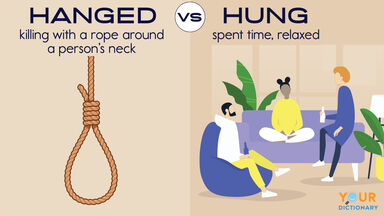
Usage Note: Hanged, as a past tense and a past participle of hang, is used in the sense of “to put to death by hanging,” as in Frontier courts hanged many a prisoner after a summary trial. A majority of the Usage Panel objects to hung used in this sense. In all other senses of the word, hung is the preferred form as past tense and past participle, as in I hung my child's picture above my desk.

Learn more about hang

hang

link/cite print suggestion box