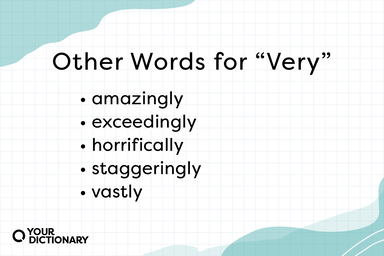
Very is defined as extremely or really.
(adverb)An example of very is someone saying they are extra happy.
The definition of very is something complete or something identical.
(adjective)An example of very is the absolute end of a story.
See very in Webster's New World College Dictionary
adjective
Origin: ME verai, true < OFr < VL *veraius < L verus, true < IE *weros, true < base *wer-, to be friendly, true > Ger wahr, true, OE wær, a compact
adverb
See very in American Heritage Dictionary 4
adverb
Origin:
Origin: Middle English verrai
Origin: , from Old French verai, true
Origin: , from Vulgar Latin *vērācus
Origin: , from Latin vērāx, vērāc-, truthful
Origin: , from vērus, true; see wērə-o- in Indo-European roots
. Usage Note: In general, very is not used alone to modify a past participle. Thus we may say of a book, for example, that it has been very much praised, very much criticized, very much applauded, and so on, but not that it has been very praised, very criticized, or very applauded. However, when past participle forms are used as adjectives, modification by a bare very, or by analogous adverbs such as quite, is acceptable: there can be no objection to phrases such as a very creased handkerchief, a very celebrated singer, or a very polished performance. In some cases there is disagreement as to whether a particular participle can be properly used as an adjective: over the years objections have been raised to very immediately preceding delighted, interested, annoyed, pleased, disappointed, and irritated. All these words are now well established as adjectives, as indicated by the fact that they can be used attributively (a delighted audience, a pleased look, a disappointed young man) as well as by other syntactic criteria. But the status of other participles is still in flux. Some speakers accept phrases such as very appreciated, very astonished, or very heartened, while others prefer alternatives using very much. What is more, some participles allow treatment as adjectives in one sense but not another: one may speak of a very inflated reputation, for example, but not, ordinarily, of a very inflated balloon. As a result, there is no sure way to tell which participles may be modified by a bare very—syntactic tests such as the use of the participle as an attributive adjective will themselves yield different judgments for different speakers—and writers must trust their ears. When in doubt, the use of very much is generally the safer alternative.Learn more about very