Too Definition
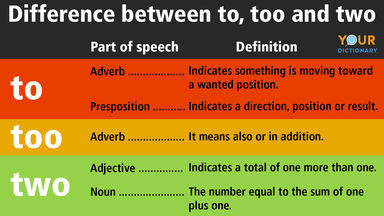
to͝o
adverb
In addition; as well; besides; also.
Webster's New World
More than enough; superfluously; overly.
The hat is too big.
Webster's New World
To a regrettable extent.
That's too bad!
Webster's New World
Extremely; very.
It was just too delicious!
Webster's New World
Indeed; so.
You will too do it!
American Heritage
Synonyms:
Antonyms:
Origin of Too
-
Middle English to (“also, in addition to"), from Old English tō (“furthermore, also, besides"), adverbial use of preposition tō (“to, into"). The sense of "in addition, also" deriving from the original meaning of "apart, separately" (compare Old English prefix tō- (“apart")). More at to.
From Wiktionary
-
Middle English to from Old English tō to, furthermore de- in Indo-European roots
From American Heritage Dictionary of the English Language, 5th Edition
Related Articles



Find Similar Words
Find similar words to too using the buttons below.