mill

The definition of a mill is a machine that grinds solid materials into smaller pieces.

(noun)

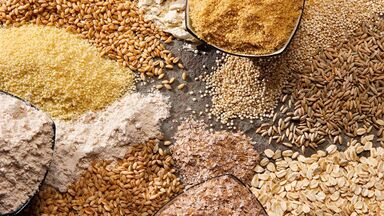
An example of a mill is a place where flour is made by grinding grain.

Mill is defined as to grind or press into smaller parts or to cut around the edges.

(verb)

An example of to mill is to press apples into cider using a cider mill.

YourDictionary definition and usage example. Copyright © 2013 by LoveToKnow Corp.

See mill in Webster's New World College Dictionary

noun

    1. a building with machinery for grinding grain into flour or meal
    2. the machine for grinding grain
    1. a machine for grinding or pulverizing any solid material: a coffee mill
    2. a machine for grinding or crushing fruits or vegetables to press out the juice: a cider mill
    1. any of various machines for stamping, shaping, polishing, or dressing metal surfaces, coins, etc., or for making something by some action done again and again
    2. Informal an organization, establishment, etc. where things are done, produced, issued, etc. in a routine, rapid, mechanical way: a diploma mill, a divorce mill
  1. a building or group of buildings with machinery for manufacturing or processing something; factory: a textile mill
  2. a roller of hardened steel with a raised design on it, for making a die or printing plate by pressure
    1. milling cutter
    2. milling machine
  3. a raised edge, ridged surface, etc. made by milling

Origin: ME melle < OE mylen, akin to OHG mulin, ON mylna, all < 4th-c. Gmc borrowing < LL molinae, pl. of molina, mill < LL(Ec) molina, of a mill < L mola, millstone < IE base *mel-, to grind, crush > meal, mild, Ger mahlen, Gr mylē, mill, L mollis, soft, molere, to grind

transitive verb

  1. to grind, work, process, form, polish, etc. by, in, or as in a mill
  2. to raise and ridge the edge of (a coin), as a safeguard against wear and clipping; knurl
  3. Now Rare to beat or whip (chocolate, etc.) to a froth

intransitive verb

☆ to move slowly in a circle, as cattle, or aimlessly, as a confused crowd: often with around or about

noun

one tenth of a cent: $.001: a monetary unit used in calculating but not as a coin

Origin: for L millesimus, thousandth < mille, thousand: cf. cent

noun

Slang mil

  1. Mill, James 1773-1836; Scot. philosopher, historian, & economist
  2. Mill, John Stuart 1806-73; Eng. philosopher & economist: son of James

See mill in American Heritage Dictionary 4

noun
  1. a. A building equipped with machinery for grinding grain into flour or meal.
    b. A device or mechanism that grinds grain.
  2. A machine or device that reduces a solid or coarse substance into pulp or minute grains by crushing, grinding, or pressing: a pepper mill.
  3. A machine that releases the juice of fruits and vegetables by pressing or grinding: a cider mill.
  4. a. A machine, such as one for stamping coins, that produces something by the repetition of a simple process.
    b. A steel roller bearing a raised design, used for making a die or a printing plate by pressure.
    c. Any of various machines for shaping, cutting, polishing, or dressing metal surfaces.
  5. a. A building or group of buildings equipped with machinery for processing raw materials into finished or industrial products: a textile mill; a steel mill.
    b. A building or collection of buildings that has machinery for manufacture; a factory.
  6. A process, agency, or institution that operates in a routine way or turns out products in the manner of a factory: The college was nothing more than a diploma mill.
  7. A slow or laborious process: It took three years to get the bill through the legislative mill.
verb milled, mill·ing, mills
verb, transitive
  1. To grind, pulverize, or break down into smaller particles in a mill.
  2. To transform or process mechanically in a mill.
  3. To shape, polish, dress, or finish in a mill or with a milling tool.
  4. a. To produce a ridge around the edge of (a coin).
    b. To groove or flute the rim of (a coin or other metal object).
  5. To agitate or stir until foamy.
  6. Western U.S. To cause (cattle) to move in a circle or tightening spiral in order to stop a stampede.
verb, intransitive
  1. To move around in churning confusion: “A crowd of school children milled about on the curb looking scared” (Anne Tyler).
  2. Slang To fight with the fists; box.
  3. To undergo milling.

Origin:

Origin: Middle English milne, mille

Origin: , from Old English mylen

Origin: , from Late Latin molīna, molīnum

Origin: , from

Origin: feminine and neuter of molīnus, of a mill

Origin: , from Latin mola, millstone

Origin: , from molere, to grind; see melə- in Indo-European roots

.

Regional Note: To mill, in Western U.S. English, means “to run cattle in a circle, sometimes deliberately in order to halt a stampede.” In the Oxford English Dictionary we find this 19th-century example of the verb: “At last the cattle ran with less energy, and it was presently easy to ‘mill’ them into a circle and to turn them where it seemed most desirable” (Munsey's Magazine). This usage of mill comes from the resemblance of the cattle's circular motion to the action of millstones. A related intransitive sense of the verb is better known in Standard English, as shown in the Oxford English Dictionary citation of an 1888 quotation from Theodore Roosevelt: “The cattle may begin to run, and then get ‘milling’-that is, all crowd together into a mass like a ball, wherein they move round and round.” Originally this sense of mill also meant “circular motion”; now it means “to move around in churning confusion” with no pattern in particular.

noun Abbr. M. or mi.
A monetary unit equal to 1/1000 of a U.S. dollar or 1/10 of a cent.

Origin:

Origin: Short for Latin mīllēsimus, thousandth; see mil1

.

Scottish philosopher, economist, and a founder of utilitarianism. His works include An Analysis of the Phenomena of the Human Mind (1829).

, John Stuart 1806-1873.

British philosopher and economist known especially for his interpretations of empiricism and utilitarianism. His many works include A System of Logic (1843), Principles of Political Economy (1848), and The Subjection of Women (1869).

Learn more about mill

link/cite print suggestion box