consonant Hear it!

consonant Definition

con·so·nant (-nənt)

adjective

  1. in harmony or agreement; in accord
  2. harmonious in tone
  3. Prosody having consonance
  4. consonantal

Etymology: OFr < L consonans: see consonance

noun

  1. any speech sound in the production of which the speaker completely stops and then releases the air stream, as in (p, t, k, b, d, g), stops it at one point while it escapes at another, as in (m, n, ŋ, l, r), forces it through a loosely closed or very narrow passage, as in (f, v, s, z, s̸h, z̸h, t̸h, t̸h, H, kh, h, w, y), or uses a combination of these means, as in (c̸h, j)
  2. a letter or symbol representing such a sound
  3. Linguis. any phoneme, esp. one produced as described above, that does not form the peak of a syllable

consonant Related Forms
con·so·nantly adverb
consonant Synonyms

consonant

n.

  1. Linguistic terms referring to consonant sounds include: voiceless, voiced; labial, bilabial, labiodental, apical, dental, alveolar, retroflex, frontal, alveopalatal, prepalatal, dorsal, palatal, velar, uvular, glottal, pharyngeal, interdental, labiovelar; stop, fricative, spirant, lenis, resonant, sibilant; aspirated, unaspirated, affricated, glottalized, preaspirated, prenasalized, implosive, plosive, nasal; click, glide, continuant, trill, flap.

  2. In spelling, English consonants are: b, c, d, f, g, h, j, k, l, m, n, p, q, r, s, t, v, w, x, y, z;

consonant Usage Examples

Converse of object

  • voice: It also helps learners to become conscious of the muscle movements involved in voicing a consonant.
  • double: But how do you know when to double the consonant and when not to?
  • contain: This fragment contains only 20 Greek consonants ( whole or damaged ) on five lines.
  • follow: Instead they seem to be arranged in groups of similar sounding consonants followed by the vowels.
  • have: In addition, an early stage of the language is thought to have had a further consonant whose identity remains uncertain.

Adjective modifier

  • voiceless: In the case of voiceless and voiced pairs, the voiceless consonant appears on the left hand side.
  • dotted: If you don't know how to key the dotted consonants, you can find out here.
  • nasal: Both languages have an assimilation process which spreads nasality from a nasal consonant to the preceding vowel.
  • Hebrew: The Old Testament Jehovah is the traditional translation of the Hebrew consonants YHWH - the special name for the one true God.
  • initial: The evidence is that the phonetic symbolism is not based on similarity of initial consonants.
  • final: Instead, Glaswegians are just giving in to the natural tendency in language not to pronounce the final consonant.

Modifies a noun

  • digraph: A10 Question 10 asked which words from the wordbank contained a consonant digraph.
  • phoneme: Some aspects of the historical development of English consonant phonemes.
  • cluster: Another type of final consonant cluster involves a nasal.
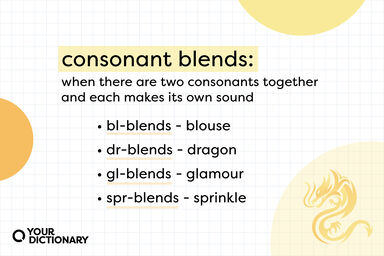
  • blend: Spelling Spell most CVC words correctly and begin to use consonant blends.
  • duration: In addition, the Bayesian model reliably predicts consonant duration in cases of missing or hidden linguistic factors.
  • sound: The initial and final consonant sound of short words are also covered.

Noun used with modifier

  • stop: In the first experiment, two relatively distinct vowels were compared with two confusable stop consonants.

Preposition: in

  • word: The consonants in the word are conveyed by short sentences, each beginning with one of the consonants.

Preposition: with