Cannon Definition
kănən
cannoned, cannons
noun
cannons
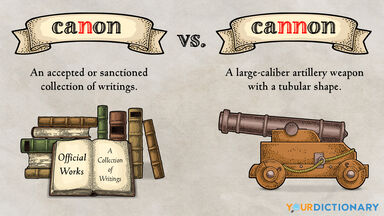
A large, mounted piece of artillery; sometimes, specif., a large gun with a relatively short barrel, as a howitzer.
Webster's New World
An automatic gun, mounted on an aircraft.
Webster's New World
A part on a bell by which it is hung.
Webster's New World
A round bit for a horse.
American Heritage Medicine
Webster's New World
verb
cannoned, cannons
To attack with cannon fire.
Webster's New World
To fire cannons.
Webster's New World
To cause to carom.
Webster's New World
To make a carom.
Webster's New World
To fire something, especially spherical, rapidly.
Wiktionary
Origin of Cannon
-
Middle English canon from Old French from Old Italian cannone augmentative of canna tube from Latin reed cane
From American Heritage Dictionary of the English Language, 5th Edition
-
Borrowed around 1400 from Old French canon, from Italian cannone, from Latin canna.
From Wiktionary
This spelling was not fixed until about 1800.
From Wiktionary

Cannon Is Also Mentioned In
Find Similar Words
Find similar words to cannon using the buttons below.