Book Definition
bo͝ok
booked, booking, books
noun
books
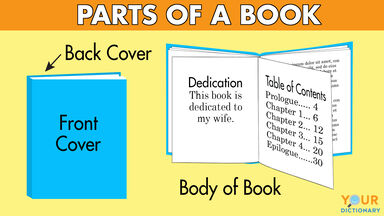
A number of sheets of paper, parchment, etc. with writing or printing on them, fastened together along one edge, usually between protective covers.
Webster's New World
An e-book or other electronic resource structured like a book.
American Heritage
A literary or scientific work, anthology, etc. so prepared, distinguished by length and form from a magazine, tract, etc.
Webster's New World
A printed or written literary work.
Did you ever finish writing that book?
American Heritage
Any of the main divisions of a long written or printed work, as of the Bible.
Webster's New World
Synonyms:
- ledger
- roster
- register
- record
- playscript
- script
- volume
- book of account
- account-book
- léger
- rule-book
- record book
- al-Qur'an
- quran
- koran
verb
booked, booking, books
To arrange for or purchase (tickets or lodgings, for example) in advance; reserve.
American Heritage
To move or travel rapidly.
We booked along at a nice clip.
American Heritage
To engage ahead of time, as rooms, transportation, performers or performances, etc.
Webster's New World
To arrange a reservation, as for a hotel room, for (someone).
Book me into the best hotel in town.
American Heritage
To record in a book; list.
Webster's New World
Synonyms:
adjective
In, from, or according to books or accounts.
Webster's New World
Of or relating to knowledge learned from books rather than actual experience.
Has book smarts but not street smarts.
American Heritage
Appearing in a company's financial records.
Book profits.
American Heritage
Synonyms:
- clothbound
- cased
- casebound
- bibliophilic
- softcover
- paperback
- hardcover
- bibliotaphic
- bibliopegistical
- bibliolatrous
idiom
bring to book
- To demand an explanation from; call to account.
American Heritage
in (one's) book
- In one's opinion:
In my book they both are wrong.
American Heritage
like a book
- Thoroughly; completely:
I know my child like a book.
American Heritage
one for the books
- A noteworthy act or occurrence.
American Heritage
throw the book at
- To make all possible charges against (a lawbreaker, for example).
- To reprimand or punish severely.
American Heritage
Idioms, Phrasal Verbs Related to Book
- bring to book
- in (one's) book
- like a book
- one for the books
- throw the book at
- bring to book
- by the book
- close the book on
- close the books
- in one's book
- in one's good (or bad) books
- in the book
- keep books
- know (or read) like a book
- make book
- one for the books
- on the books
- the Book
- the book
- throw the book at
- write the book on
Origin of Book
-
Middle English bok from Old English bōc bhāgo- in Indo-European roots
From American Heritage Dictionary of the English Language, 5th Edition
Perhaps shortening and alteration (influenced by book) of boogie
From American Heritage Dictionary of the English Language, 5th Edition



Book Is Also Mentioned In
Find Similar Words
Find similar words to book using the buttons below.