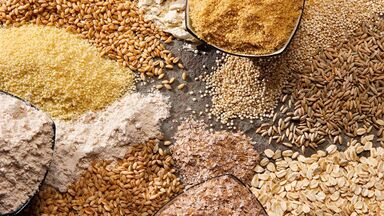
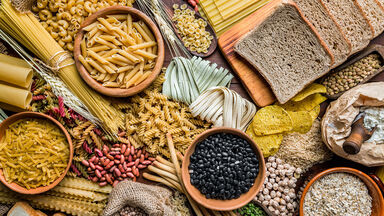
grain

The definition of a grain is a tiny hard seed from a cereal grass, or a tiny piece of amount of something.

(noun)

  1. An example of a grain is a piece of a wheat berry.
  2. An example of a grain is an extremely tiny piece of sand.

YourDictionary definition and usage example. Copyright © 2013 by LoveToKnow Corp.

See grain in Webster's New World College Dictionary

noun

  1. a small, hard seed or seedlike fruit, esp. that of any cereal plant, as wheat, rice, corn, rye, etc.
  2. : also called corn in Great Britain
    1. cereal seeds in general
    2. the seeds of a specific cereal
    3. any plant or plants producing cereal seeds
    1. a tiny, solid particle, as of salt or sand
    2. a crystal or crystals collectively; also crystallization, esp. of sugar
  3. a tiny bit; slightest amount: a grain of sense
  4. Origin: orig. from the weight of a grain of wheat

    the smallest unit in the system of weights used in the U.S., Great Britain, and Canada, equal to .0648 gram: one pound avoirdupois equals 7,000 grains; one pound troy or apothecaries' weight equals 5,760 grains: abbrev. gr
    1. the arrangement or direction of fibers, layers, or particles of wood, leather, stone, paper, etc.
    2. the markings or texture due to a particular arrangement
    3. paint or other surface finish imitating such markings or texture
    4. a granular surface appearance
    1. that side of a piece of leather from which the hair has been removed
    2. the markings on that side
    1. disposition; nature
    2. essential quality
  5. Obsolete
    1. kermes or cochineal
    2. a red dye made from either
    3. any fast dye
    4. Archaic color or shade

Origin: ME greyne < OFr grein, a seed, grain (< L granum, a seed, kernel) & grainne, seed or grain collectively (< LL grana, fem., orig. pl. of L granum) < IE base *ĝer-, to become ripe > corn, kernel

transitive verb

  1. to form into grains; granulate
  2. to paint or otherwise finish (a surface) in imitation of the grain of wood, marble, etc.
    1. to remove the hair from (hides)
    2. to put a finish on the grain surface of (leather)

intransitive verb

to form grains

See grain in American Heritage Dictionary 4

noun
  1. a. A small, dry, one-seeded fruit of a cereal grass, having the fruit and the seed walls united: a single grain of wheat; gleaned the grains from the ground one at a time. Also called caryopsis.
    b. The fruits of cereal grasses especially after having been harvested, considered as a group: The grain was stored in a silo.
  2. a. A cereal grass: Wheat is a grain grown in Kansas.
    b. Cereal grasses considered as a group: Grain is grown along the river.
  3. a. A relatively small discrete particulate or crystalline mass: a grain of sand.
    b. A small amount or the smallest amount possible: hasn't a grain of sense.
  4. Aerospace A mass of solid propellant.
  5. Abbr. gr. A unit of weight in the U.S. Customary System, an avoirdupois unit equal to 0.002285 ounce (0.065 gram). See Table at measurement.
  6. The arrangement, direction, or pattern of the fibrous tissue in wood.
  7. a. The side of a hide or piece of leather from which the hair or fur has been removed.
    b. The pattern or markings on this side of leather.
  8. The pattern produced, as in stone, by the arrangement of particulate constituents.
  9. The relative size of the particles composing a substance or pattern: a coarse grain.
  10. A painted, stamped, or printed design that imitates the pattern found in wood, leather, or stone.
  11. The direction or texture of fibers in a woven fabric.
  12. A state of fine crystallization.
  13. a. Basic temperament or nature; disposition.
    b. An essential quality or characteristic.
  14. Archaic Color; tint.
verb grained, grain·ing, grains
verb, transitive
  1. To cause to form into grains; granulate.
  2. To paint, stamp, or print with a design imitating the grain of wood, leather, or stone.
  3. To give a granular or rough texture to.
  4. To remove the hair or fur from (hides) in preparation for tanning.
verb, intransitive
To form grains.

Origin:

Origin: Middle English

Origin: , from Old French graine

Origin: , from Latin grānum; see gṛə-no- in Indo-European roots

.

Related Forms:

  • grainˈer noun

Learn more about grain

link/cite print suggestion box